Minimum Auto Insurance Requirements by State: 2026 Coverage Limits & Laws
Minimum auto insurance requirements by state vary based on local coverage laws. Liability-only coverage starts at $49/monthly with USAA, and Geico also offers competitive rates. Compare state minimums, coverage types, and liability limits below.
Read more





Table of Contents
Table of Contents

Published Insurance Expert
Melanie Musson is the fourth generation in her family to work in the insurance industry. She grew up with insurance talk as part of her everyday conversation and has studied to gain an in-depth knowledge of state-specific car insurance laws and dynamics as well as a broad understanding of how insurance fits into every person’s life, from budgets to coverage levels. She also specializes in sustai...
Melanie Musson

Head of Content
Meggan McCain, Head of Content, has been a professional writer and editor for over a decade. She leads the in-house content team at Quote.com. With three years dedicated to the insurance industry, Meggan combines her editorial expertise and passion for writing to help readers better understand complex insurance topics. As a content team manager, Meggan sets the tone for excellence by guiding c...
Meggan McCain

Commercial Lines Coverage Specialist
Michael Vereecke is the president of Customers First Insurance Group. He has been a licensed insurance agent for over 13 years. He also carries a Commercial Lines Coverage Specialist (CLCS) Designation, providing him the expertise to spot holes in businesses’ coverage. Since 2009, he has worked with many insurance providers, giving him unique insight into the insurance market, differences i...
Michael Vereecke
Updated September 2026
Minimum auto insurance requirements by state vary, with different rules for liability insurance, personal injury protection, and uninsured motorist coverage.
- Alaska requires one of the highest minimum liability limits at 50/100/25
- Florida only mandates $10K in PIP and $10K in property damage liability
- New Hampshire generally does not mandate auto insurance
Most states require drivers to have liability insurance. Some states also require personal injury protection, medical payments coverage, or uninsured motorist coverage.
If you do not maintain the state-required car insurance, you could lose your license, have your registration revoked, pay fines exceeding $1K, or be required to file an SR-22.
Enter your ZIP code to compare the cheapest auto insurance companies that meet legal state insurance requirements.
State Auto Insurance Coverage Laws
Do all states require car insurance? New Hampshire is the only state that generally does not mandate auto insurance or another form of financial responsibility for all drivers. Other states require insurance or proof of financial responsibility, although some allow qualifying alternatives to a traditional policy.
State liability requirements help ensure drivers can pay for injuries or property damage they cause. If you have liability auto insurance, it means you can cover the costs if you cause damage in an accident. In New Hampshire, the 25/50/25 coverage limits only apply if you buy insurance or are required by law to have it.
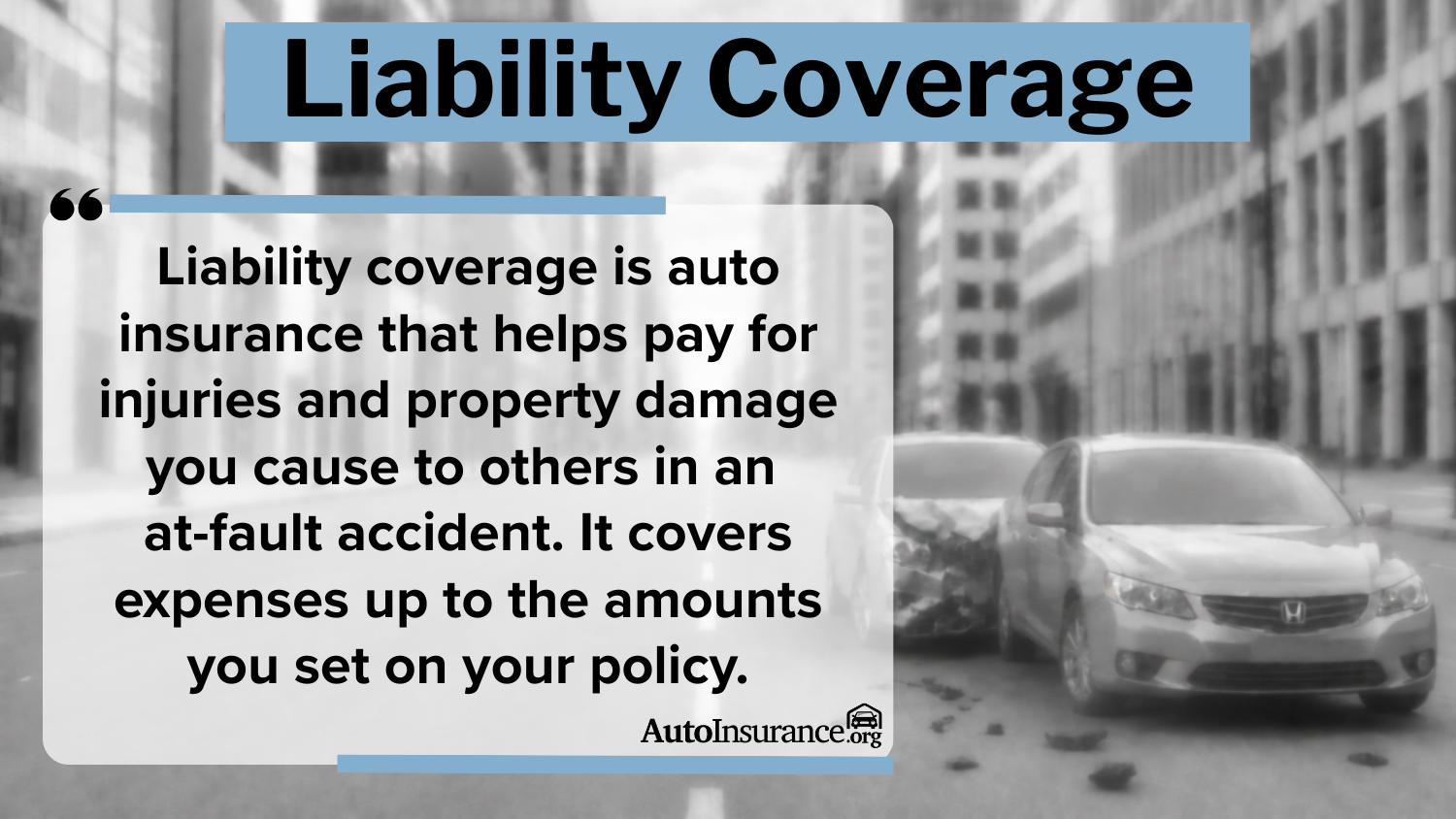
This is why most states only require auto liability insurance. You can choose not to protect your own car, but other drivers shouldn’t be financially responsible for damage you cause.
Check your state’s minimum auto insurance requirements to confirm you meet the legal coverage limits.
Minimum Car Insurance Requirements by State
| State | Liability | UM/UIM | PIP/MedPay | Fault System |
|---|---|---|---|---|
| Alabama | 25/50/25 | ❌ | ❌ | At-Fault |
| Alaska | 50/100/25 | ❌ | ❌ | At-Fault |
| Arizona | 25/50/15 | ❌ | ❌ | At-Fault |
| Arkansas | 25/50/25 | ❌ | ❌ | At-Fault |
| California | 30/60/15 | ❌ | ❌ | At-Fault |
| Colorado | 25/50/15 | ❌ | ❌ | At-Fault |
| Connecticut | 25/50/25 | 25/50 | ❌ | At-Fault |
| Delaware | 25/50/10 | ❌ | PIP: $15K/$30K | At-Fault |
| Florida | 0/0/10 | ❌ | PIP: $10K | No-Fault |
| Georgia | 25/50/25 | ❌ | ❌ | At-Fault |
| Hawaii | 40/80/20 | ❌ | PIP: $10K | No-Fault |
| Idaho | 25/50/15 | ❌ | ❌ | At-Fault |
| Illinois | 25/50/20 | 25/50 | ❌ | At-Fault |
| Indiana | 25/50/25 | ❌ | ❌ | At-Fault |
| Iowa | 20/40/15 | ❌ | ❌ | At-Fault |
| Kansas | 25/50/25 | 25/50 | PIP: $4.5K | No-Fault |
| Kentucky | 25/50/25 | 25/50 | PIP: $10K | No-Fault |
| Louisiana | 15/30/25 | ❌ | ❌ | At-Fault |
| Maine | 50/100/25 | 50/100 | MedPay: $2K | At-Fault |
| Maryland | 30/60/15 | 30/60/15 | PIP: $2.5K | At-Fault |
| Massachusetts | 25/50/30 | 25/50 | PIP: $8K | No-Fault |
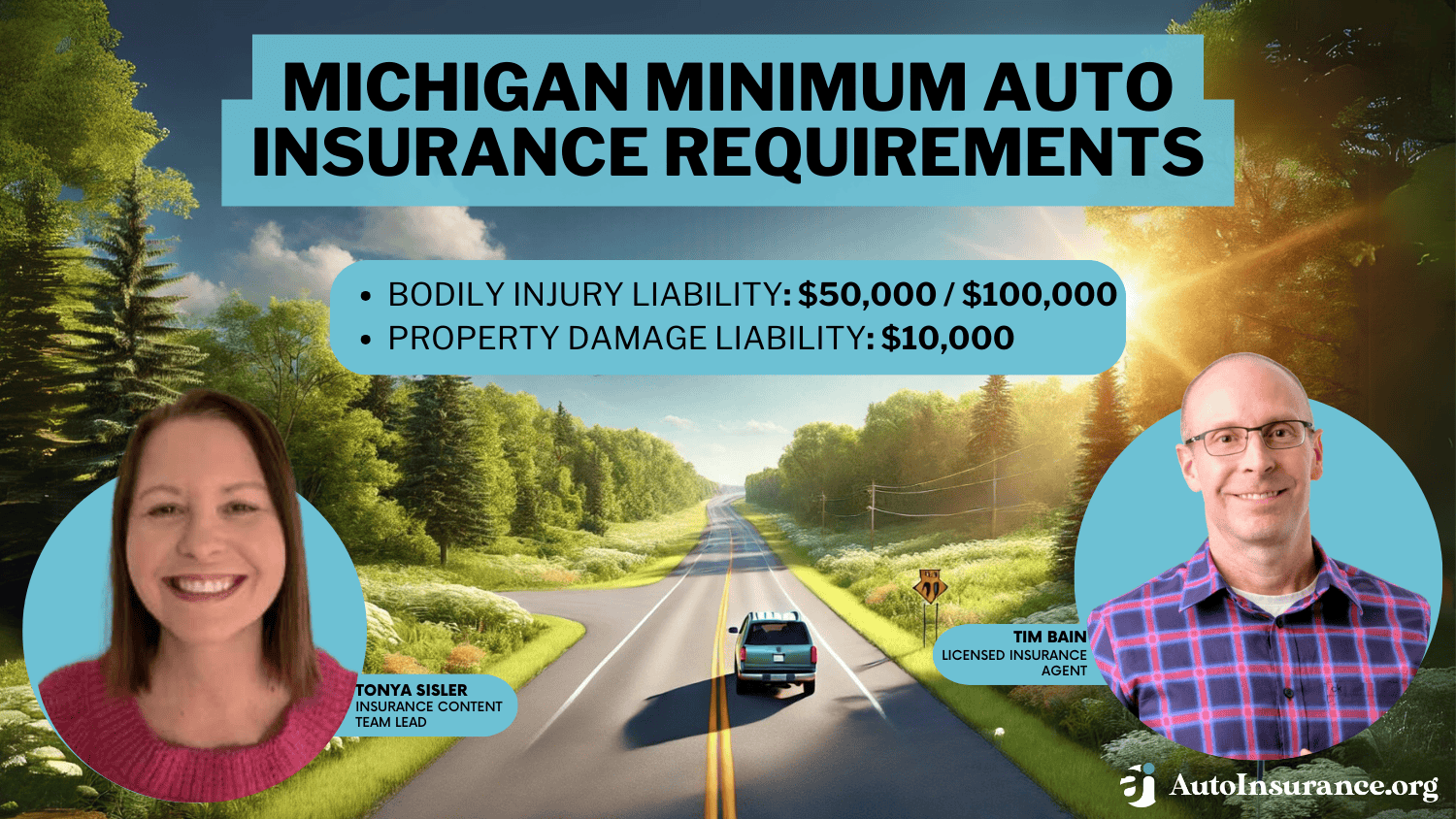
| Michigan | 50/100/10 | ❌ | PIP: Tiered | No-Fault |
| Minnesota | 30/60/10 | 25/50 | PIP: $40K | No-Fault |
| Mississippi | 25/50/25 | ❌ | ❌ | At-Fault |
| Missouri | 25/50/25 | 25/50 | ❌ | At-Fault |
| Montana | 25/50/20 | ❌ | ❌ | At-Fault |
| Nebraska | 25/50/25 | 25/50 | ❌ | At-Fault |
| Nevada | 25/50/20 | ❌ | ❌ | At-Fault |
| New Hampshire | 25/50/25 | 25/50 | ❌ | At-Fault |
| New Jersey | 35/70/25 | ❌ | PIP: $15K | No-Fault |
| New Mexico | 25/50/10 | ❌ | ❌ | At-Fault |
| New York | 25/50/10 | 25/50 | PIP: $50K | No-Fault |
| North Carolina | 50/100/50 | 50/100/50 | ❌ | At-Fault |
| North Dakota | 25/50/25 | 25/50 | PIP: $30K | No-Fault |
| Ohio | 25/50/25 | ❌ | ❌ | At-Fault |
| Oklahoma | 25/50/25 | ❌ | ❌ | At-Fault |
| Oregon | 25/50/20 | 25/50 | PIP: $15K | At-Fault |
| Pennsylvania | 15/30/5 | ❌ | PIP: $5K | No-Fault |
| Rhode Island | 25/50/25 | ❌ | ❌ | At-Fault |
| South Carolina | 25/50/25 | UM: 25/50/25 | ❌ | At-Fault |
| South Dakota | 25/50/25 | 25/50 | ❌ | At-Fault |
| Tennessee | 25/50/25 | ❌ | ❌ | At-Fault |
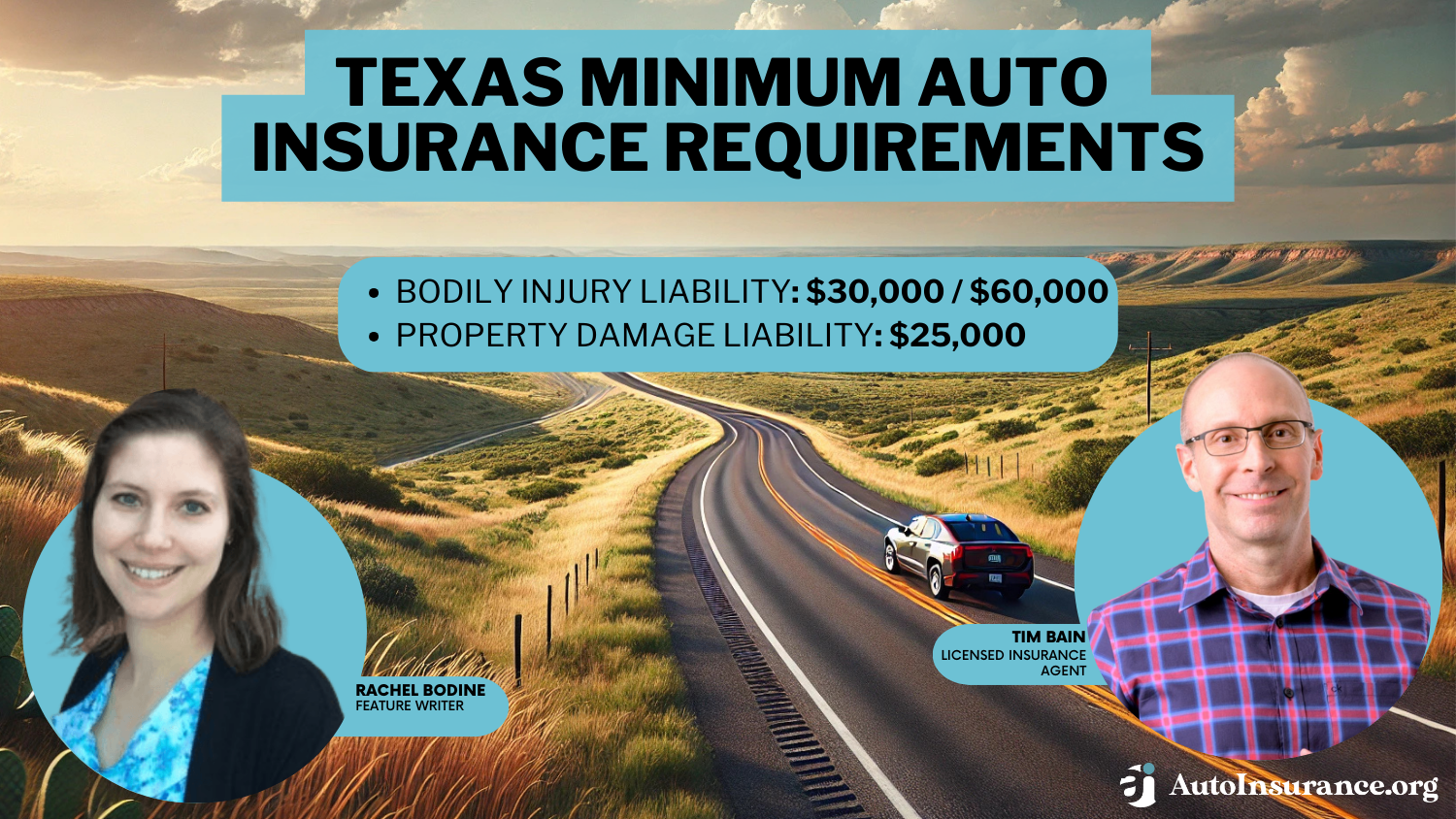
| Texas | 30/60/25 | ❌ | ❌ | At-Fault |
| Utah | 30/65/25 | ❌ | PIP: $3K | No-Fault |
| Vermont | 25/50/10 | 50/100/10 | ❌ | At-Fault |
| Virginia | 50/100/25 | 50/100/25 | ❌ | At-Fault |
| Washington | 25/50/10 | ❌ | ❌ | At-Fault |
| West Virginia | 25/50/25 | 25/50 | ❌ | At-Fault |
| Wisconsin | 25/50/10 | 25/50 | ❌ | At-Fault |
| Wyoming | 25/50/20 | ❌ | ❌ | At-Fault |
Does every state have the same requirements for coverage? Most states require a minimum amount of liability insurance.
Several other state laws include personal injury protection, medical payments, or uninsured/underinsured motorist as part of the coverage requirements.
- Minimum Auto Insurance Requirements
- How to Buy a Car With a Learner’s Permit in 2026 (6 Steps to Follow)
- Minnesota Minimum Auto Insurance Requirements in 2026 (Learn What MN Requires)
- Kansas Minimum Auto Insurance Requirements in 2026 (KS Coverage Details)
- Maryland Minimum Auto Insurance Requirements in 2026 (MD Mandated Coverage)
- Hawaii Minimum Auto Insurance Requirements for 2026 (What Drivers in HI Need)
- South Dakota Minimum Auto Insurance Requirements in 2026 (SD Coverage Explained)
- New Jersey Minimum Auto Insurance Requirements for 2026 (What Drivers in NJ Need)
- Wisconsin Minimum Auto Insurance Requirements for 2026 (Basic WI Coverage Guide)
- Wyoming Minimum Auto Insurance Requirements for 2026 (Legal WY Coverage Simplified)
- Washington D.C. Minimum Auto Insurance Requirements in 2026 (Learn What DC Requires)
- Texas Minimum Auto Insurance Requirements in 2026 (Coverage You Need in TX)
- Utah Minimum Auto Insurance Requirements for 2026 (Learn What UT Requires)
- Virginia Minimum Auto Insurance Requirements in 2026 (What VA Drivers Need to Buy)
- Washington Minimum Auto Insurance Requirements for 2026 (Coverage WA Drivers Need)
- Oklahoma Minimum Auto Insurance Requirements for 2026 (What Drivers in OK Need)
- Pennsylvania Minimum Auto Insurance Requirements in 2026 (Coverage You Need in PA)
- South Carolina Minimum Auto Insurance Requirements for 2026 (See SC Policies & Limits)
- Nevada Minimum Auto Insurance Requirements in 2026 (NV Coverage Explained)
- New Hampshire Minimum Auto Insurance Requirements for 2026 (See What NH Requires Here!)
- New Mexico Minimum Auto Insurance Requirements for 2026 (NM Mandated Coverage)
- North Carolina Minimum Auto Insurance Requirements in 2026 (Coverage NC Drivers Need)
- Massachusetts Minimum Auto Insurance Requirements for 2026 (MA Mandated Coverage)
- Michigan Minimum Auto Insurance Requirements in 2026 (Coverage You Need in MI)
- Mississippi Minimum Auto Insurance Requirements for 2026 (What Drivers in MS Need)
- Missouri Minimum Auto Insurance Requirements for 2026 (Coverage MO Drivers Need)
- Montana Minimum Auto Insurance Requirements for 2026 (Coverage You Need in MT)
- Indiana Minimum Auto Insurance Requirements for 2026 (What IN Drivers Need)
- Kentucky Minimum Auto Insurance Requirements in 2026 (Coverage You Need in KY)
- Louisiana Minimum Auto Insurance Requirements in 2026 (See What All LA Drivers Need)
- Connecticut Minimum Auto Insurance Requirements in 2026 (CT Mandated Coverage)
- Florida Minimum Auto Insurance Requirements in 2026 (FL Coverage Guide)
- Georgia Minimum Auto Insurance Requirements in 2026 (Coverage GA Drivers Need)
- Idaho Minimum Auto Insurance Requirements (What ID Drivers Need in 2026)
- Arkansas Minimum Auto Insurance Requirements in 2026 (AR Mandated Coverage)
- Colorado Minimum Auto Insurance Requirements in 2026 (Everything CO Drivers Should Know)
- Alabama Minimum Auto Insurance Requirements in 2026 (What AL Drivers Need)
- Alaska Minimum Auto Insurance Requirements in 2026 (What AK Drivers Need to Buy)
- Arizona Minimum Auto Insurance Requirements in 2026 (What AZ Drivers Should Know)
- Auto Insurance Laws
- Do all vehicles have set auto insurance requirements? (2026 Coverage Facts)
- Do you have to have auto insurance in every state?
- Can police check your auto insurance?
- Is not having auto insurance a criminal offense?
- Can you drive alone with a permit? (2026)
- Do you need auto insurance if you don’t drive your car?
- Are you allowed to buy or register a car with a suspended license?
- Is it illegal to live in your car? (2026)
- What is a DWI? (Definition + Consequences in 2026)
- Vehicle Registration Fees by State (2026)
- What happens if you drive without a license and get stopped by the police?
- DWI vs. DUI Differences Explained for 2026 (Understand the Terms)
- Is it illegal to sleep in your car?
- Where can I legally sleep in my car?
- What is a DUI? (+Penalties in 2026)
- Police Citation: What All Drivers Should Know in 2026
- Is it illegal to drive barefoot?
- Do all vehicles have set auto insurance requirements? (2026 Coverage Facts)
- Do you need insurance to test drive a car at the dealership?
- Do I need proof of insurance when buying a used car? (2026)
- Texas Driving Laws for Seniors (2026)
- Do you need proof of insurance to transfer a car title?
- California Driving Laws for Seniors (2026)
- Are backup cameras required on new vehicles?
- Washington D.C. Child Car Seat Laws (2026)
- New Hampshire Child Car Seat Laws (2026)
- Idaho Child Car Seat Laws (2026)
- Delaware Child Car Seat Laws (2026)
- Alabama Child Car Seat Laws (2026)
- Does your car need to be registered to get auto insurance? (2026)
- Do you need auto insurance to get a license plate? (2026)
- Do you need proof of insurance to rent a car?
- Do you have to have auto insurance in every state?
- How many days after purchase do you have to get auto insurance?
- Can police check your auto insurance?
- Is not having auto insurance a criminal offense?
- Do teens need auto insurance if they have a license but no car?
- When did auto insurance become mandatory?
- Who governs Florida auto insurance companies?
- Auto Insurance Laws (2026)
Types of Auto Insurance Required by State
State requirements often include more than just liability insurance, so it helps to know how each type of required coverage can protect you financially.
You may have seen different types of coverage listed as state requirements for car insurance.
- Liability: This covers injuries and property damage you cause in an accident. Each state sets its own required coverage limits.
- Medical Payments: MedPay covers medical expenses for you and your passengers, no matter who was at fault in the accident.
- Personal Injury Protection: PIP helps pay for medical bills, lost wages, funeral costs, and other related expenses after an accident.
- Uninsured/Underinsured Motorist: UM/UIM protects you if you are hurt or your car is damaged by a driver who has little or no insurance, or in a hit-and-run.
In no-fault states, drivers use their own insurance first, which is why PIP or MedPay is usually required.
In most states, drivers need to have at least the minimum liability insurance from a licensed insurer before they can register and drive a car legally.
Least Strict States for Car Insurance Requirements
New Hampshire is the only state in which the majority of drivers are legally allowed to drive without auto insurance, even though they are still liable for any damage they cause.
To meet its financial responsibility requirement, California will accept either a $75K deposit with the DMV, a $75K surety bond, or approved self-insurance rather than liability coverage.
Washington allows a deposit or liability bond of $60K as well, and Texas and Missouri accept bonds, deposits, and qualifying self-insurance.
Other states provide more limited options, meaning that eligibility will vary according to the driver, the vehicle they own, and the particular requirements of the state.
Related: Which states have the cheapest auto insurance rates?
How No-Fault and At-Fault Insurance Systems Work
In no-fault states, drivers typically turn to their own PIP coverage first for accident-related injuries, regardless of who caused the crash.
In places where a driver is found to be at fault, the driver who caused the accident is made financially responsible, and the injuries and damages suffered by the other person are paid for by liability insurance.
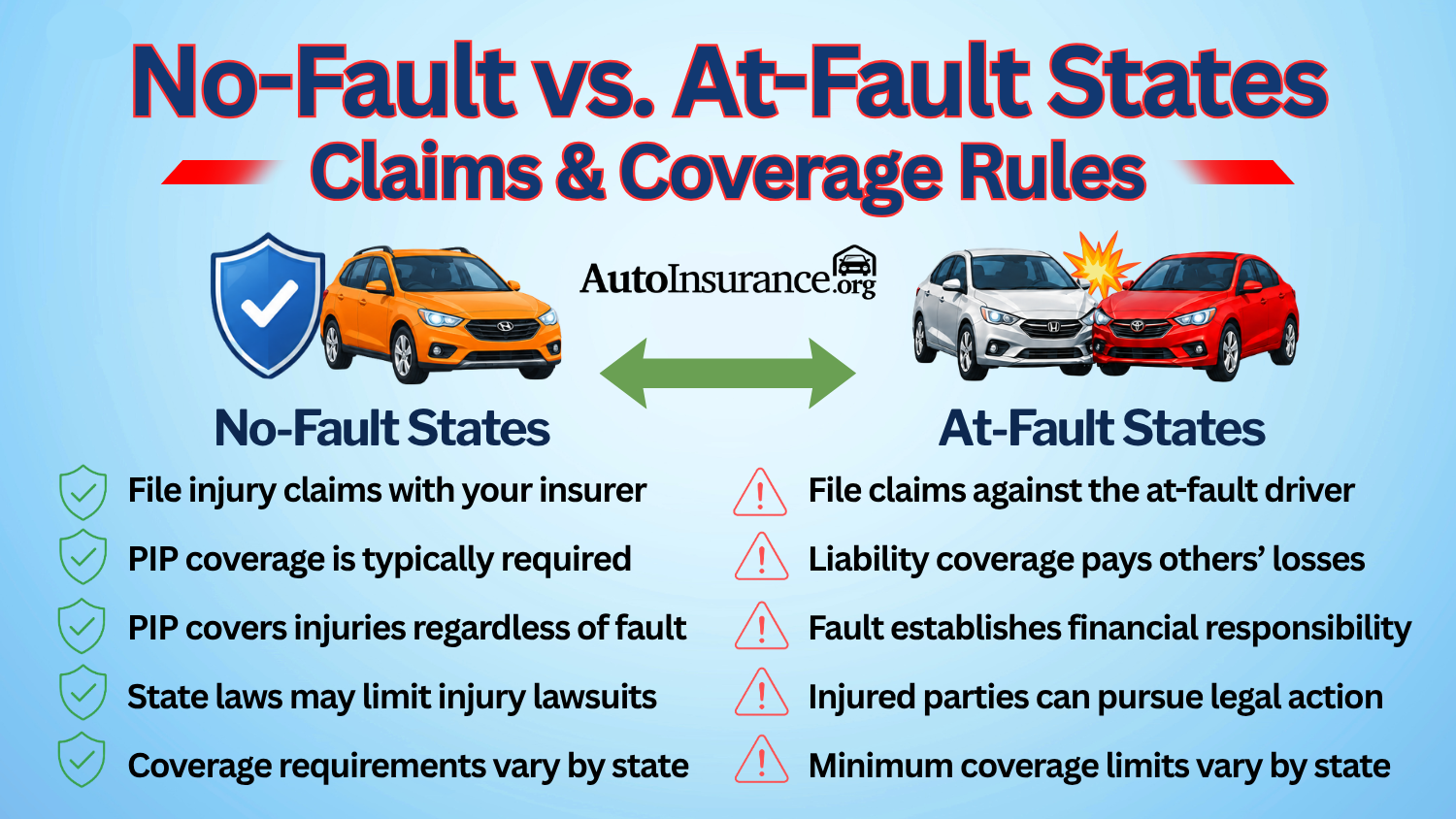
Although no-fault systems may make it easier to file medical claims, they generally only permit lawsuits when the injuries meet certain thresholds established by the state.
Drivers injured in an accident may pursue compensation from the at-fault driver and, when allowed, file a lawsuit for additional damages.
See More: Best Auto Insurance Without Penalties for No-Fault Accidents
Additional Car Insurance Coverage Options
Minimum car insurance usually costs less than policies with higher limits. Many drivers choose extra coverage to better protect their cars.
Common optional coverage types include:
- Collision Coverage: Pays for repairs to your car after an accident, no matter who was at fault. This is especially helpful for protecting newer vehicles from costly losses.
- Comprehensive Coverage: Helps with losses from theft, vandalism, weather events, fire, or animal damage. It covers more than just accidents.
- Gap Insurance: Pays off the rest of your car loan if your vehicle is totaled and its value is less than what you still owe.
- Rental Car Reimbursement: Covers the cost of a rental car while your own car is being repaired after a covered accident.
- Roadside Assistance: Helps in emergencies by offering towing, battery jumps, fuel delivery, and help with flat tires.
Higher limits and optional coverage can reduce your out-of-pocket costs after a covered loss.
Financed cars may need more than state minimums. In particular, lenders often require both collision and comprehensive.Laura Berry Former Licensed Insurance Producer
Compare optional coverage based on your vehicle, budget, and potential out-of-pocket costs.
Free Insurance Comparison
Compare Quotes From Top Companies and Save
Consequences for Driving Uninsured by State
Driving without auto insurance can get expensive even before you are involved in an accident.
In New York, penalties can reach $1,500. In Arizona, fines stay around $500 for these violations.
State-Specific Penalties for Driving Without Insurance
| State | Fine | Suspension | SR-22 Required |
|---|---|---|---|
| Alabama | $500 | Registration | ✅ |
| Alaska | $500 | 90 days | ✅ |
| Arizona | $500 | 3 months | ✅ |
| Arkansas | $50–$250 | Registration | ✅ |
| California | $100–$200 | Registration | ✅ |
| Colorado | $500 | Until compliant | ✅ |
| Connecticut | $100–$1,000 | 1 month | ✅ |
| Delaware | $1,500–$2,000 | 6 months | ❌ |
| Florida | $150 | Up to 3 years | ✅ |
| Georgia | $200–$1,000 | 60 days | ✅ |
| Hawaii | $500 | 3 months | ✅ |
| Idaho | $75 | Until compliant | ✅ |
| Illinois | $500–$1,000 | Up to 4 months | ✅ |
| Indiana | $250 | 90 days | ✅ |
| Iowa | $250 | Registration | ✅ |
| Kansas | $300–$1,000 | Until compliant | ✅ |
| Kentucky | $500–$1,000 | 1 year | ❌ |
| Louisiana | $500–$1,000 | Registration | ✅ |
| Maine | $100–$500 | Until compliant | ✅ |
| Maryland | Up to $1,000 | Registration | ❌ |
| Massachusetts | Up to $1,000 | 60 days | ❌ |
| Michigan | $200–$500 | 30 days | ✅ |
| Minnesota | $200–$1,000 | 30 days–1 year | ✅ |
| Mississippi | $500 | Up to 1 year | ✅ |
| Missouri | Up to $500 | Until compliant | ✅ |
| Montana | $250–$500 | Registration | ✅ |
| Nebraska | Up to $1,000 | Until compliant | ✅ |
| Nevada | $250–$1,000 | Registration | ✅ |
| New Hampshire | ❌ | ❌ | ❌ |
| New Jersey | $300–$1,000 | 1 year | ❌ |
| New Mexico | Up to $300 | Registration | ✅ |
| New York | $150–$1,500 | Insurance lapse | ❌ |
| North Carolina | $50 | 30 days | ❌ |
| North Dakota | $150–$1,000 | Until compliant | ✅ |
| Ohio | $160–$660 | Until compliant | ✅ |
| Oklahoma | Up to $250 | Until compliant | ✅ |
| Oregon | $130–$1,000 | Until compliant | ✅ |
| Pennsylvania | $500 | 3 months | ❌ |
| Rhode Island | $100–$500 | 3 months | ✅ |
| South Carolina | $100–$200 | Until compliant | ✅ |
| South Dakota | Up to $500 | Up to 1 year | ✅ |
| Tennessee | Up to $300 | Until compliant | ✅ |
| Texas | $175–$350 | Registration | ✅ |
| Utah | $400 | Until compliant | ✅ |
| Vermont | $250–$500 | Until compliant | ✅ |
| Virginia | $600 | Until compliant | ✅ |
| Washington | $550+ | Up to 1 year | ❌ |
| Washington, D.C. | Up to $2,500 | 30-60 days | ✅ |
| West Virginia | $200–$5,000 | Up to 30 days | ✅ |
| Wisconsin | Up to $500 | Until SR-22 | ✅ |
| Wyoming | $250–$750 | Until compliant | ✅ |
New Hampshire generally does not require drivers to carry auto insurance. Certain drivers may be required to provide proof of financial responsibility after an accident, conviction, or other qualifying event.
Some states also suspend your driving privileges. In Florida, suspensions can last up to three years after an offense.
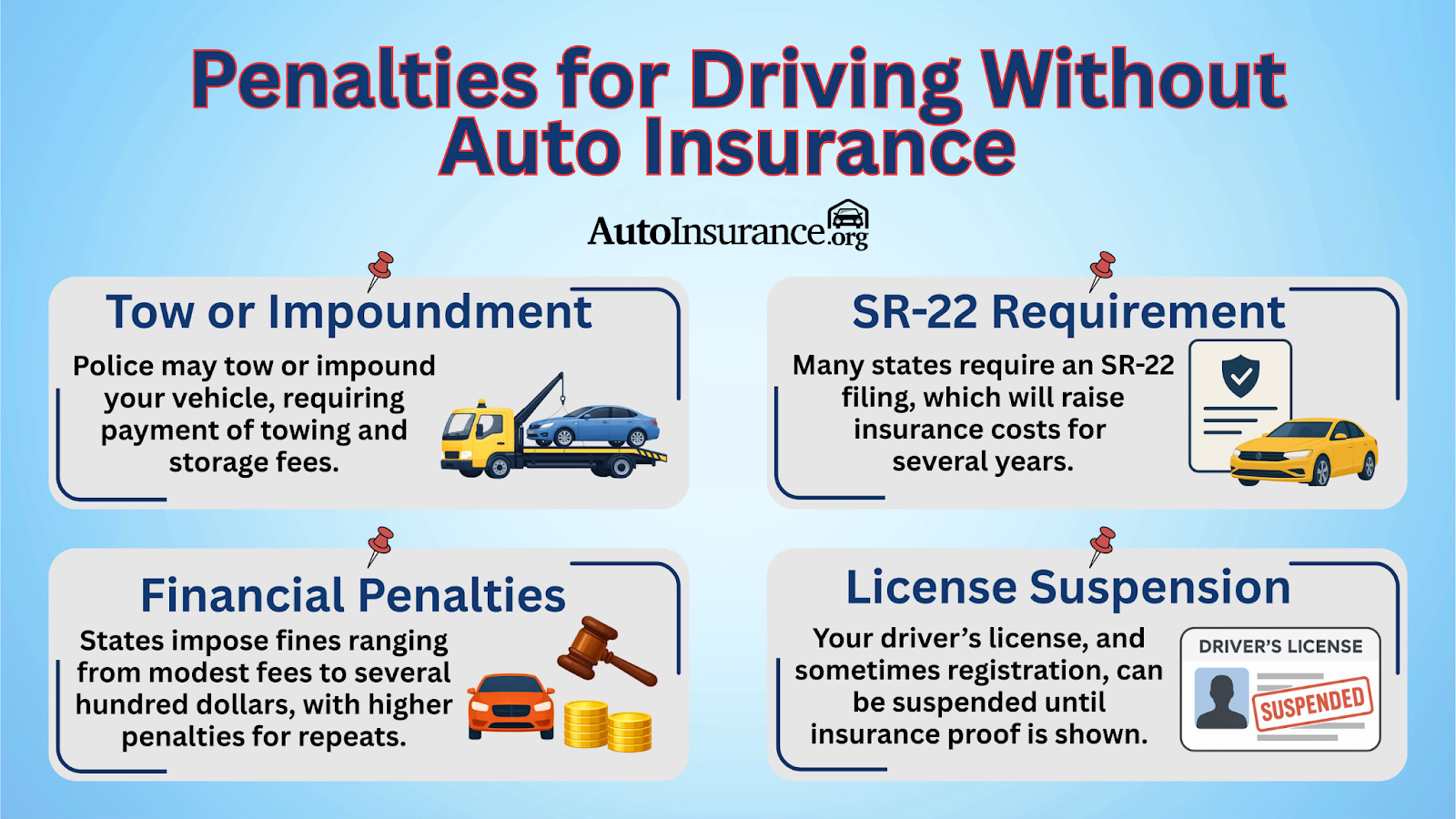
If you drive without insurance, you could face serious legal and financial problems, which depend on the state where you live.
In addition to immediate penalties, drivers without insurance might have to pay higher insurance rates, cover court costs, and be personally responsible for any damages if they cause an accident.
- Fines: Most states impose fines for driving without required insurance, with penalties varying by state.
- License Suspension: You could lose your license until you get insurance and meet the reinstatement requirements.
- Registration Suspension: Your vehicle registration could be suspended, so you would not be allowed to drive your car legally.
- SR-22 Requirement: Many drivers have to file an SR-22 form to show they will be financially responsible in the future.
- Vehicle Impoundment: In some states, your car could be taken away until you pay the required fees and show proof of insurance.
Higher limits and optional coverage can reduce your out-of-pocket costs after a covered loss.
If you cause an accident without insurance, you could be sued, have to pay for medical bills and repairs yourself, be required to go to court, and in serious or repeat cases, even face jail time.
Minimum Car Insurance Costs by State
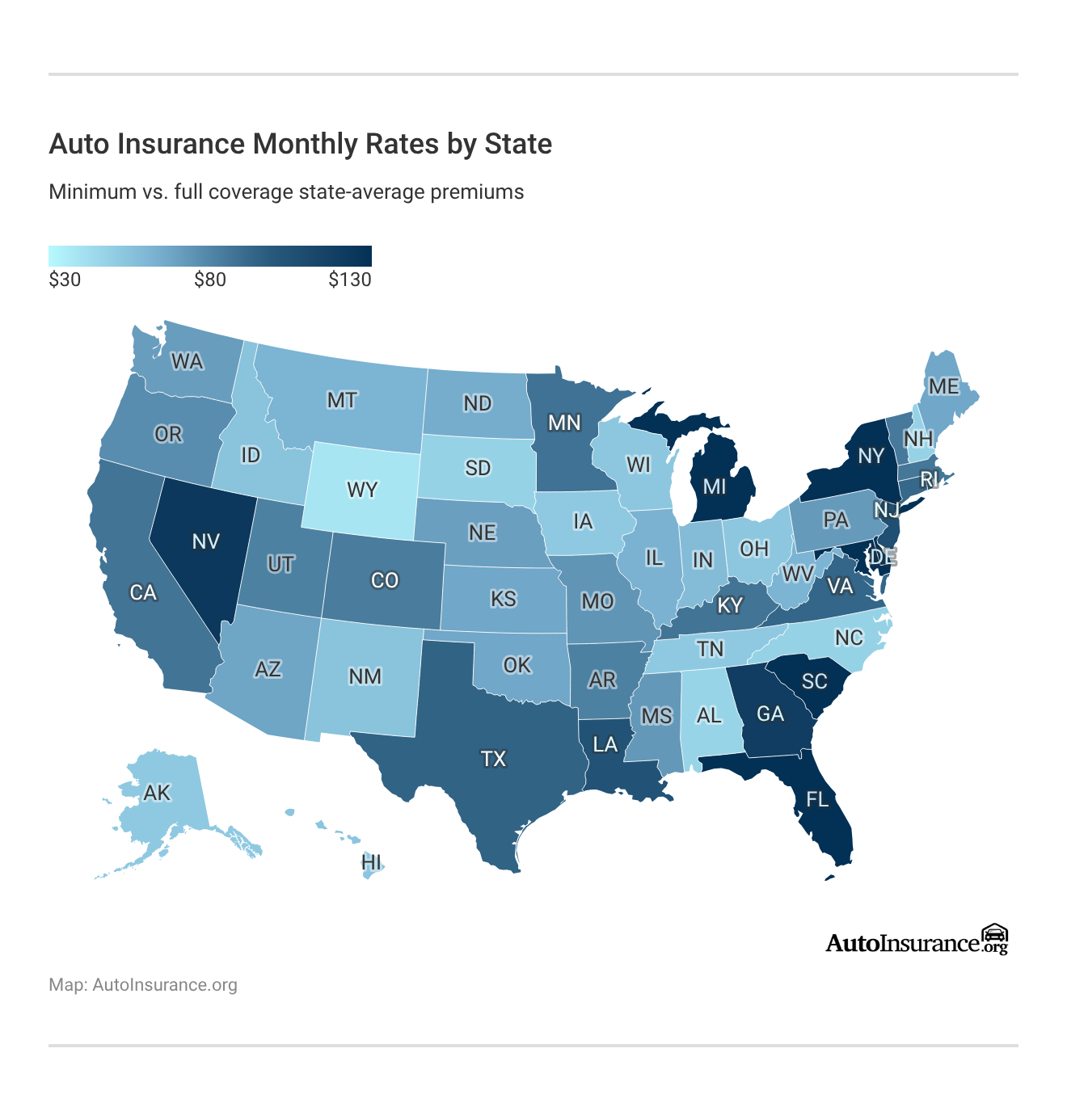
Monthly car insurance costs vary widely depending on the state, so your location matters when you compare minimum and full coverage options. Read More: Auto Insurance Rates by State
In Maryland, minimum coverage costs $168 per month, while full coverage is $289. This makes Maryland one of the more expensive states for car insurance.
Wyoming is much less expensive, with minimum coverage at $39 per month and full coverage at $90.
Drivers should weigh the savings of minimum coverage against the extra protection of full coverage to choose a policy that fits both their car’s needs and their budget.
In the United States, each state has its own auto insurance regulations. Some states require only basic coverage, while others set higher minimum coverage standards.
Drivers on a tight budget can compare policies that meet their state’s minimum insurance requirements.
Higher state limits can still leave you paying damages yourself. In particular, Maine requires 50/100/25 liability.
Michelle Robbins Licensed Insurance Agent
Because each state has its own insurance regulations, drivers should compare required limits carefully before choosing a policy that is affordable and meets the necessary qualifications.
Choosing state-minimum coverage can lower premiums, but higher limits may reduce out-of-pocket exposure after a serious accident.
How to Find Cheap Minimum Coverage Car Insurance
Knowing your state’s minimum auto insurance requirements can help you avoid fines of over $1K, license suspensions, and registration problems.
Liability-only coverage costs about $49 per month on average, so comparing quotes is a good way to find better rates. Check Out This Page: Best Auto Insurance Companies
Liability-Only vs. Full Coverage Monthly Rates by Provider
| Insurance Company | Liability-Only | Full Coverage |
|---|---|---|
 | $78 | $175 |
 | $69 | $157 |
 | $56 | $128 |
 | $74 | $172 |
 | $55 | $126 |
 | $82 | $186 |
 | $63 | $151 |
 | $71 | $166 |
 | $59 | $133 |
 | $70 | $160 |
 | $49 | $112 |
Basic liability policies meet legal requirements, but coverage limits like 25/50/25 can run out quickly after a serious accident. Getting more coverage than your state requires can help protect you from large bills after an accident.
Compare quotes from several insurers because premiums and available discounts vary by company.
Auto Insurance Premiums Based on Coverage Amounts
Car insurance premiums vary by insurer, so comparing quotes can help identify lower-priced coverage.
USAA has the lowest rates, with minimum coverage costing $49 per month and full coverage costing $112 per month.
Auto Insurance Monthly Rates by Coverage Level
| Insurance Company | Minimum Coverage | Full Coverage |
|---|---|---|
| $78 | $175 |
| $69 | $157 |
| $56 | $128 |
| $74 | $172 |
| $55 | $126 |
| $82 | $186 |
| $63 | $151 |
| $71 | $166 |
| $59 | $133 |
| $70 | $160 |
| $49 | $112 |
Erie is next, offering minimum coverage for $56 per month and full coverage for $128 monthly. In contrast, Liberty Mutual charges $186 per month for full coverage.
If you choose higher coverage limits, your monthly payments will go up, but you could pay much less out of pocket if you have an expensive accident. Compare minimum car insurance requirements by using our free quote comparison tool.
Frequently Asked Questions
Is car insurance required in all states?
No. New Hampshire is the only state that generally does not require drivers to carry auto insurance. Other states require drivers to meet minimum insurance or financial responsibility requirements, although some allow qualifying alternatives such as a cash deposit, surety bond, or self-insurance.
Which auto insurance is mandatory in most states?
Most states require liability insurance, while some mandate additional coverage depending on local laws. Common required insurance types include:
- Bodily injury liability
- Property damage liability
- Uninsured/underinsured motorist coverage
- Personal injury protection
- Medical payments coverage
Requirements vary by state, so drivers should confirm which coverage types and limits apply where they live. Compare affordable insurers that offer coverage meeting your state’s requirements.
What is the minimum car insurance required to drive legally?
Minimum auto insurance requirements refer to the legally mandated amount of coverage that drivers must carry in each state. These requirements vary from state to state and typically include liability coverage for bodily injury and property damage. Related Info: Cheapest Auto Insurance Companies
How do minimum auto insurance requirements vary by state?
The state-required insurance varies in terms of the specific coverage amounts and types mandated. Each state sets its own coverage types and minimum limits through state insurance and financial responsibility laws.
Enter your ZIP code to compare coverage options that meet your state’s minimum requirements.
Why do states have minimum auto insurance requirements?
State requirements for car insurance exist to ensure that drivers have a basic level of financial responsibility in case they cause accidents or damage to others.
Does New Hampshire require car insurance?
No. New Hampshire generally does not require drivers to carry car insurance. However, drivers are financially responsible for damages they cause, and some drivers may be required to provide proof of financial responsibility after certain accidents or violations.
Related Info: Best New Hampshire Auto Insurance
Is 50/100/50 enough insurance?
50/100/50 provides more liability protection than many state minimums, but whether it is enough depends on your financial situation and potential liability exposure. Compare quotes from multiple auto insurance providers with our free comparison tool.
Can I purchase more than the minimum required auto insurance coverage?
Yes. Drivers can choose liability limits above their state minimums and add optional coverage such as collision or comprehensive for additional financial protection.
How can I find out the minimum auto insurance requirements in my state?
To verify car insurance requirements by state, drivers can check their state’s DMV website or contact the agency directly for current coverage rules.
What do 25/50/25 auto insurance limits mean?
The 25/50/25 auto insurance limits provide up to $25K for bodily injury per person, $50K for bodily injury per accident, and $25K for property damage per accident.
Do I really need comprehensive and collision?
What is the cheapest state to have auto insurance?
What is the Alaska minimum car insurance requirement?
What is the state minimum car insurance in Colorado?
What is the state minimum car insurance in Georgia?
What is the state minimum car insurance in Illinois?
What are the Indiana minimum car insurance requirements?
What is the state minimum car insurance in Kentucky?
What are the Minnesota minimum auto insurance requirements?
What is the state minimum car insurance in Nevada?
What are the car insurance requirements in Tennessee?
What are the Vermont car insurance requirements?
What are the minimum car insurance requirements in Wisconsin?
What are the Wyoming car insurance requirements?
Related Articles
-
Jun 2026

Vehicle Registration Fees by State (2026)
-
Mar 2025
Arizona Minimum Auto Insurance Requirements in 2026 (What AZ Drivers Should Know)
-
Oct 2024
Best Windshield Replacement Coverage in Louisiana (Top 10 Companies in 2026)
-
Feb 2025
Michigan Minimum Auto Insurance Requirements in 2026 (Coverage You Need in MI)
-
Jun 2026
How to File an Auto Insurance Claim in 2026 (Follow These 3 Steps)
-
Mar 2025
Texas Minimum Auto Insurance Requirements in 2026 (Coverage You Need in TX)
Get a FREE Quote in Minutes
Insurance rates change constantly — we help you stay ahead by making it easy to compare top options and save.