
Vehicle Registration Fees by State (2026)
Vehicle registration fees by state vary based on vehicle type, weight, fuel type, and age. Maine and Nevada have some of the highest listed registration costs, while Georgia has the lowest, starting at $20. Compare fees below and find out how much it costs to register a vehicle in your state.
Read more




Table of Contents
Table of Contents

Insurance Content Team Lead
Tonya Sisler has been a technical insurance writer for over five years. She uses her extensive insurance and finance knowledge to write informative articles that answer readers' top questions. Her mission is to provide readers with timely, accurate information that allows them to determine their insurance needs and choose the best coverage. Tonya currently leads a team of 10 insurance copywrite...
Tonya Sisler

Managing Editor
Aleksandra J. Churlinov holds a Bachelor of Arts in English Language and Literature and a Master of Science in Marketing Management. Over the past six years, Aleks has focused on the insurance sector, working on a range of content, including business, auto, and life insurance. In April 2025, she stepped into the role of Managing Editor, where she now leads a team of talented insurance writers. ...
Aleksandra J. Churlinov

Licensed Insurance Agent
Tim Bain is a licensed insurance agent with 23 years of experience helping people protect their families and businesses with the best insurance coverage to meet their needs. His insurance expertise has been featured in several publications, including Investopedia and eFinancial. He also does digital marking and analysis for KPS/3, a communications and marking firm located in Nevada.
Tim Bain
Updated October 2026
Why are registration fees so expensive? Like auto insurance rates by state, vehicle registration fees by state vary because states use different pricing formulas.
- Additional taxes and vehicle-related fees may increase registration costs
- California, Florida, and New York permit some nonresident registrations
- Wisconsin lists a $215 vehicle title fee, compared with Arizona’s $4 fee
Vehicle age, weight, and fuel efficiency can influence registration charges, but states don’t calculate them the same way. Oregon, for example, uses fuel economy to determine certain passenger vehicle registration fees, while other states consider vehicle value or weight.
The comparisons below cover registration charges, title fees, and other requirements that may affect your total cost. Even if your registration is expensive, your insurance doesn’t have to be. Enter your ZIP code to compare auto insurance quotes from multiple providers.
How Vehicle Registration Costs Vary Across States
Vehicle registration costs vary across the U.S., with each state using its own rules to calculate fees. Some charge a flat fee, while others consider a vehicle’s age, weight, or value. Local taxes and additional charges can also affect what drivers pay.
Registration periods also differ: some states collect fees annually, while others charge for two years. The costs below compare estimated registration fees by state, including Washington, D.C. Actual amounts may vary depending on your vehicle and location.
Vehicle Registration Fees By State
| State | Fees | State Fees Explained | State Registration |
|---|---|---|---|
| Alabama | $23 | Standard renewal | AL DOR |
| Alaska | $100 | Two-year registration | AK DMV |
| Arizona | $518 | Includes vehicle license tax | AZ MVD |
| Arkansas | $28 | Based on vehicle weight | AR DFA |
| California | $533 | Includes value-based fees | CA DMV |
| Colorado | $514 | Based on age and value | CO DOR |
| Connecticut | $150 | Registration term varies | CT DMV |
| Delaware | $40 | Standard annual renewal | DE DMV |
| Florida | $46 | Based on vehicle weight | FL HSMV |
| Georgia | $20 | Standard annual renewal | GA DOR |
| Hawaii | $112 | County fees extra | HI County DMV |
| Idaho | $69 | Based on vehicle age | ID DOT |
| Illinois | $151 | Standard renewal | IL SOS |
| Indiana | $444 | Includes excise tax | IN BMV |
| Iowa | $365 | Based on value and weight | IA DOT |
| Kansas | $43 | Vehicle property tax extra | KS DOR |
| Kentucky | $21 | Vehicle property tax extra | KY SOS |
| Louisiana | $70 | Two-year registration | LA OMV |
| Maine | $648 | Includes excise tax | ME SOS |
| Maryland | $166 | Weight-based registration | MD MVA |
| Massachusetts | $555 | Includes excise tax | MA DMV |
| Michigan | $187 | Based on vehicle MSRP | MI SOS |
| Minnesota | $547 | Includes value-based tax | MN DVS |
| Mississippi | $29 | Ad valorem tax extra | MS DOR |
| Missouri | $33 | Vehicle property tax extra | MO DOR |
| Montana | $232 | Based on vehicle age | MT MVD |
| Nebraska | $592 | Includes vehicle taxes | NE DMV |
| Nevada | $615 | Includes service tax | NV DMV |
| New Hampshire | $568 | Includes municipal fees | NH DMV |
| New Jersey | $84 | Based on weight and age | NJ MVC |
| New Mexico | $62 | Based on weight and age | NM MVD |
| New York | $84 | Two-year weight-based | NY DMV |
| North Carolina | $46 | Vehicle property tax extra | NC DMV |
| North Dakota | $134 | Based on weight and age | ND DOT |
| Ohio | $51 | Includes local fees | OH BMV |
| Oklahoma | $98 | Based on registration age | OK DOR |
| Oregon | $136 | Two-year fuel-based fee | OR DMV |
| Pennsylvania | $53 | Standard renewal | PA DMV |
| Rhode Island | $61 | Two-year registration | RI DMV |
| South Carolina | $40 | Two-year fee; tax extra | SC DMV |
| South Dakota | $120 | Based on weight and age | SD DOR |
| Tennessee | $29 | Local wheel tax extra | TN DOR |
| Texas | $75 | Includes standard fees | TX DMV |
| Utah | $205 | Includes age-based fees | UT DMV |
| Vermont | $76 | Standard renewal | VT DMV |
| Virginia | $31 | Local property tax extra | VA DMV |
| Washington | $444 | Includes regional fees | WA DOL |
| Washington, DC | $175 | Annual weight-based fee | DC DMV |
| West Virginia | $52 | Vehicle property tax extra | WV DMV |
| Wisconsin | $85 | Local wheel tax extra | WI DOT |
| Wyoming | $555 | Includes county fees | WY DOT |
Estimated registration fees range widely, from $20 in Georgia to $648 in Maine. Some figures cover two years, while others exclude local taxes, so the listed amounts may not reflect every driver’s final cost.
Looking for states with lower vehicle registration fees? Georgia and Alabama have some of the lowest estimated charges in our comparison. Drivers can also explore the cheapest auto insurance companies to help manage their overall vehicle expenses.
The type of vehicle you drive can also affect registration costs. Gasoline-powered cars and hybrids may have different fees, particularly in states that charge extra for certain fuel-efficient vehicles. Those differences can add to the cost of keeping a vehicle registered.
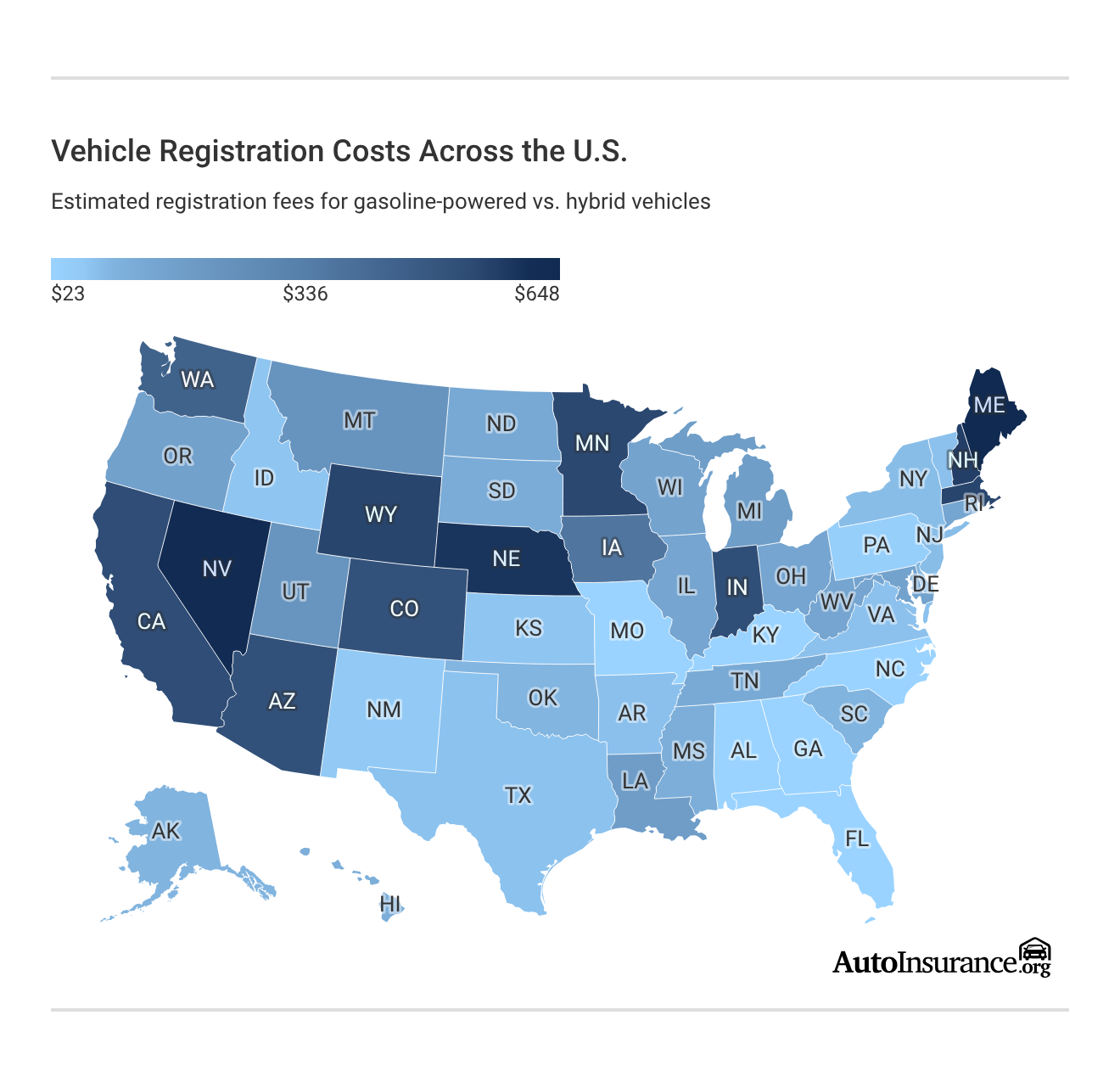
The map below shows how registration expenses differ across the country, with darker shades representing higher estimated costs. Hover over each state to compare gasoline and hybrid fees and see where the differences are most noticeable.
Registration fees for conventional hybrids can be higher in states that charge additional fees for fuel-efficient vehicles. Other states apply the same basic registration rules to both vehicle types. The final amount may also depend on the car’s value, weight, or registration period.
Electric vehicles may face separate registration charges that don’t apply to conventional hybrids. Drivers considering an EV can explore our article, electric vehicle auto insurance discounts, for other ways to reduce ownership expenses.
Free Insurance Comparison
Compare Quotes From Top Companies and Save
States With Higher Vehicle Registration Costs
States with higher vehicle registration costs may base their fees on vehicle value, weight, or fuel economy. For example, Oregon charges different amounts depending on a passenger car’s gas mileage. These rules can make registration more expensive for certain vehicles.
Oregon divides passenger vehicle registration fees into three fuel-economy categories, with separate rates for vehicles enrolled in its OReGO program. The charges also vary depending on whether registration covers two or four years.
- Passenger 0-19 mpg: $252 for four years or $126 for two years
- Passenger 20-39 mpg: $272 for four years or $136 for two years
- Passenger 40+ mpg (Without OReGO): $432 for four years or $216 for two years
- Passenger 40+ mpg (With OReGO): $172 for four years or $86 for two years
Oregon’s registration system charges more for vehicles that use less gasoline. Drivers with cars rated at 40 MPG or higher may qualify for reduced registration fees by joining OReGO, the state’s mileage-based road usage program.
New passenger vehicles generally receive four-year registration, while subsequent renewals cover two years. County fees and other applicable charges can increase the total, so drivers should check their vehicle’s fuel economy before calculating their costs.
Registration is only one part of owning a vehicle in Oregon. Drivers can also compare coverage options in our guide to Oregon auto insurance before moving on to states with lower registration charges.
States With the Lowest Vehicle Registration Fees
Some states have lower basic registration charges, although the final amount can increase with vehicle-specific fees and local taxes. Georgia, Alabama, and Mississippi have relatively low estimated charges in our comparison.
Registration costs can also depend on whether a state collects annual renewal fees or charges for multiple years. The following examples highlight lower estimated amounts from our state-by-state comparison:
- Alabama: Estimated registration fee of $23, with the final cost varying by vehicle and county.
- Arkansas: Estimated registration fee of $28, with separate charges possible for certain vehicles.
- Georgia: Estimated registration fee of $20, with additional charges possible depending on the vehicle.
- Kentucky: Estimated registration fee of $21, excluding applicable local taxes and other charges.
- Mississippi: Estimated registration fee of $29, excluding applicable taxes and additional charges.
- Tennessee: Estimated registration fee of $29, with county-specific charges that may increase the total.
Lower registration fees can reduce vehicle ownership expenses, but a state’s listed amount may not include every required charge. County taxes, license plate fees, and vehicle-specific assessments can increase what drivers actually pay.
Drivers should also consider how often they need to renew their registration. A state with a low annual fee may have different long-term costs than one that collects payments every two years. Insurance requirements can also affect the renewal process. Find out more: Does your car need to be registered to get auto insurance?
A low registration fee is only one part of keeping a car affordable. Drivers should consider insurance, maintenance, and other ownership expenses when comparing costs across states.Jeffrery Manola Licensed Insurance Agent
Registration fees are only one part of vehicle ownership costs. Insurance premiums also vary by location, driving history, and coverage. Explore our New Hampshire auto insurance guide for a closer look at coverage costs.
Even when registration charges are relatively low, insurance expenses can noticeably affect a driver’s overall budget. Comparing both costs can help drivers understand what they may spend to keep their vehicles legally registered and insured.
A vehicle’s insurance premium depends on different factors than its registration fees. While states establish registration charges, insurers assess driver and vehicle details when determining coverage prices.

Insurance premiums and registration fees are separate expenses that drivers need to budget for. Even states with low basic registration charges may collect additional taxes or vehicle-specific fees, increasing the total amount drivers pay.
Understanding how states calculate registration charges can help drivers prepare for these differences. Vehicle age, weight, value, and location can all influence the amount owed, which brings us to the factors behind registration costs.
Factors Affecting Vehicle Registration Costs
Vehicle registration fees aren’t calculated the same way in every state. Some use fixed charges, while others adjust fees based on the vehicle type, fuel efficiency, or whether it’s a first-time registration.
New registrations and renewals may also follow different fee schedules. The infographic below highlights the main factors states consider when determining registration costs and why drivers may receive different bills.

Fuel efficiency and vehicle type can affect registration expenses, particularly for electric and hybrid cars. First-time registrations may also include title, plate, or other one-time charges that aren’t collected during renewals. County requirements can add further costs.
Before registering a vehicle, drivers should review their state’s fees, required documents, and insurance rules. Since requirements vary by location, it’s worth checking our guide: Does your car need to be registered to get auto insurance?
Free Insurance Comparison
Compare Quotes From Top Companies and Save
Fees That May Increase Vehicle Registration Costs
Beyond the standard registration charge, drivers may encounter separate fees for license plates, title transfers, and emissions-related requirements. These costs depend on state rules and the services required to register a vehicle.
- Emissions Testing Fee: Covers required emissions inspections in certain states or counties to ensure vehicles meet local air quality standards.
- License Plate Fee: Applies when drivers receive new or replacement plates; costs vary by state and plate type.
- Specialty Plate Fee: Covers personalized or specialty plates, which may carry additional issuance or renewal charges.
- Title Transfer Fee: Covers updating vehicle ownership records after a purchase or transfer. Explore our Florida auto insurance guide for coverage options.
- Vehicle Inspection Fee: Pays for required vehicle safety inspections, which may check brakes, lights, tires, and other components.
Additional vehicle fees don’t apply to every driver or transaction. Some are collected during initial registration, while others arise when a vehicle needs an inspection, plate replacement, or updated ownership records.
These charges can increase the total amount due beyond the standard registration fee. Knowing which expenses apply helps drivers prepare for registration costs, including the title and licensing charges discussed next.
Understanding Vehicle Title and Licensing Costs
Vehicle title fees cover the paperwork used to establish or transfer ownership, while initial registration and licensing expenses may include plate charges, vehicle-based taxes, and other state assessments. These amounts can vary considerably by vehicle and location.
The comparison below uses estimates for a $35,000 gasoline-powered passenger car weighing approximately 3,800 pounds. Some costs cover multiple years or exclude local taxes, so drivers should confirm their actual charges before registering. Helpful Info: Do you need auto insurance to get a license plate?
State Title and License Fees
| State | Title Fee | License Fee |
|---|---|---|
| Alabama | $17 | $23 |
| Alaska | $15 | $100 |
| Arizona | $4 | $598 |
| Arkansas | $10 | $28 |
| California | $28 | $563 |
| Colorado | $7 | $693 |
| Connecticut | $25 | $150 |
| Delaware | $35 | $40 |
| Florida | $76 | $299 |
| Georgia | $18 | $20 |
| Hawaii | $5 | $112 |
| Idaho | $14 | $69 |
| Illinois | $165 | $151 |
| Indiana | $15 | $505 |
| Iowa | $25 | $365 |
| Kansas | $10 | $43 |
| Kentucky | $9 | $21 |
| Louisiana | $77 | $70 |
| Maine | $33 | $875 |
| Maryland | $200 | $166 |
| Massachusetts | $75 | $848 |
| Michigan | $15 | $208 |
| Minnesota | $23 | $580 |
| Mississippi | $9 | $29 |
| Missouri | $18 | $33 |
| Montana | $12 | $242 |
| Nebraska | $10 | $655 |
| Nevada | $28 | $646 |
| New Hampshire | $25 | $683 |
| New Jersey | $60 | $98 |
| New Mexico | $8 | $62 |
| New York | $50 | $109 |
| North Carolina | $67 | $46 |
| North Dakota | $5 | $134 |
| Ohio | $18 | $51 |
| Oklahoma | $11 | $98 |
| Oregon | $106 | $298 |
| Pennsylvania | $72 | $53 |
| Rhode Island | $53 | $74 |
| South Carolina | $15 | $40 |
| South Dakota | $10 | $120 |
| Tennessee | $14 | $29 |
| Texas | $33 | $75 |
| Utah | $6 | $205 |
| Vermont | $35 | $76 |
| Virginia | $15 | $31 |
| Washington | $36 | $513 |
| District of Columbia (Washington, D.C.) | $30 | $175 |
| West Virginia | $15 | $52 |
| Wisconsin | $215 | $85 |
| Wyoming | $15 | $660 |
Estimated licensing costs vary considerably across states. Georgia and Arkansas have relatively low amounts in this comparison, while Colorado and Arizona have higher estimates. Title fees are generally smaller, although the amounts and services they cover differ by state.
Drivers should also check whether these charges apply only during initial registration or continue when renewing their plates. Beyond covering administrative costs, registration revenue helps fund public services, with each state deciding how to distribute the money based on its transportation priorities.
How States Use Vehicle Registration Fees
States collect vehicle registration fees to help pay for transportation services and administrative operations. Depending on local laws, this revenue may support road maintenance, public safety, and other programs related to vehicle ownership.
Not every state distributes the money in the same way. Some states direct revenue toward specific projects, while others allocate funds to local governments or agencies that maintain transportation systems.
- Administrative Costs: Supports vehicle registration processing, recordkeeping, and DMV operations.
- Environmental Programs: May fund emissions-related initiatives or cleaner transportation projects in certain states.
- Public Safety: Can support transportation-related enforcement and emergency services where permitted by law.
- Road Maintenance and Repairs: Helps fund road, highway, and bridge repairs and upkeep.
- Transportation Projects: May support road construction, transit improvements, and other transportation infrastructure.
- Vehicle Inspections and Emissions Testing: Can help fund inspection and emissions programs where required.
Registration revenue helps states cover a range of transportation expenses, but the amount directed toward each purpose varies. Nationwide figures provide a clearer picture of how these funds are distributed across major spending categories.
A higher vehicle registration fee doesn't necessarily mean better roads or services. What matters is how effectively states manage the revenue they collect.Brandon Frady Licensed Insurance Producer
Registration costs alone don’t show how much a state invests in its transportation system. Drivers can also look at local funding decisions and long-term infrastructure plans to understand how those charges relate to public services.
For a broader perspective, the Federal Highway Administration’s Highway Statistics provides information on motor vehicle revenue and transportation funding. These reports help put individual state charges into context before examining the nationwide figures below.
Nationwide Distribution of Motor Vehicle Revenue
To understand how motor-vehicle revenue is spent nationwide, look beyond individual state programs. Federal data show how these funds are allocated across major transportation and administrative categories.
The Federal Highway Administration tracks how states distribute motor-vehicle and motor-carrier tax and fee revenue. Its figures cover passenger cars, motorcycles, commercial vehicles, and other applicable vehicle classes, providing a broader picture of transportation funding nationwide.
State highways and local roads receive substantial portions of motor-vehicle-related revenue, helping fund construction, repairs, and ongoing maintenance. Other allocations support highway safety, public transportation, debt payments, and administrative expenses.
Some states also use vehicle-related fees to support environmental programs, inspections, and emissions testing. The national breakdown does not separately identify these activities, and funding arrangements vary by state regulations and local transportation needs.
States use registration revenue differently, but drivers should also understand the rules that apply to their vehicles. One detail to check is whether insurance and registration must be in the same name. Key Facts: Does your auto insurance and vehicle registration need to be under the same name?
How to Register a Vehicle
Registering a vehicle involves submitting the required documents, paying applicable fees, and meeting your state’s requirements. Although the basic process is similar nationwide, paperwork, costs, and deadlines can vary by state.
Most states require proof of auto insurance before registering a vehicle, although specific rules differ. Drivers should confirm their state’s coverage requirements and have their insurance information ready before applying.
Before starting the application, gather your vehicle details, ownership records, and other required paperwork. Preparing these documents in advance can prevent delays, especially when registering a newly purchased or leased car.
To register a car, you need the following:
- Driver name, address, and county
- Insurance policy number or proof of coverage
- Proof of ownership or lease agreement
- Vehicle details, including year, make, model, and VIN
- Vehicle title number, if applicable
- Vehicle type or classification
Depending on where you live, you may be able to register a car online, but many states require drivers to do so in person at the DMV.
Follow these simple steps to register your vehicle in your state:
- Gather Required Documents: Before you go to the DMV, make sure you have the documents listed above, such as proof of insurance. Your state may also require inspection certificates. Learn how to get a copy of your auto insurance card for DMV verification here.
- Complete the Registration Application: This form requires vehicle and personal information. You can complete it online or in person.
- Pass a State Inspection: Some states require minimum vehicle safety equipment, performance, and emissions testing. Make sure your vehicle meets the required standards before proceeding with registration.
- Pay Vehicle Registration Fees: Registration charges vary by state and may include taxes, license plate fees, or inspection costs. Review the amount due and available payment options before completing your application.
After your application is approved, you’ll receive registration documents and any required license plates, either immediately or by mail. Follow your state’s instructions for displaying plates and keeping your registration current. Related Info: Are you allowed to buy or register a car with a suspended license?
Once your vehicle is registered, keeping it current becomes the next responsibility. Some states offer self-service DMV kiosks that allow eligible drivers to renew their registration without waiting at a service counter. The following video explains how these options can simplify the renewal process.
Self-service kiosks offer a convenient way to handle routine renewals, but not every vehicle or registration qualifies. Drivers with expired documents, unresolved fees, or additional inspection requirements may need to complete the process through their state DMV.
Before renewing, review your registration notice for deadlines, payment options, and any required documents. Keeping your registration and insurance current can help you avoid penalties and prepare for the renewal costs discussed in the next section.
Free Insurance Comparison
Compare Quotes From Top Companies and Save
Vehicle Registration Renewal Costs and Requirements
Unfortunately, car registration isn’t free. Even if you live in the cheapest state for car registration, you’ll still have to pay at least $8. The cheapest way to renew your car registration is to pay online every year. Forgetting to renew your registration can lead to tickets or higher fees when you do renew.
Remember that vehicle registration is not a one-time process. You must renew it each year, and annual vehicle registration fees vary by state. Make sure you have the required documents when you renew, such as proof of insurance and the title.
Factors influencing vehicle fees by state include vehicle age, weight, and local taxes. See if you need auto insurance to get a license plate here.
Vehicle Registration Requirements for Nonresidents
You may need to register a vehicle in another state if you commute out of state for work or split your time between multiple states. For more details, read our complete review of the best auto insurance for out-of-state drivers.
Only a handful of states allow non-residents to register a vehicle. Check out the table to see whether your state allows non-residents to register cars:
States That Allow Non-Resident Vehicle Registration
| States | Yes/No |
|---|---|
| Alabama | No |
| Alaska | No |
| Arizona | No |
| Arkansas | No |
| California | Yes |
| Colorado | Yes |
| Connecticut | No |
| Delaware | Yes |
| Florida | Yes |
| Georgia | No |
| Hawaii | No |
| Idaho | No |
| Illinois | No |
| Indiana | Yes |
| Iowa | No |
| Kansas | No |
| Kentucky | Yes |
| Louisiana | No |
| Maine | Yes |
| Maryland | No |
| Massachusetts | Yes |
| Michigan | No |
| Minnesota | No |
| Mississippi | No |
| Missouri | No |
| Montana | No |
| Nebraska | No |
| Nevada | No |
| New Hampshire | No |
| New Jersey | No |
| New Mexico | No |
| New York | Yes |
| North Carolina | No |
| North Dakota | Yes |
| Ohio | No |
| Oklahoma | No |
| Oregon | No |
| Pennsylvania | No |
| Rhode Island | No |
| South Carolina | No |
| South Dakota | Yes |
| Tennessee | No |
| Texas | No |
| Utah | No |
| Vermont | No |
| Virginia | No |
| Washington | No |
| Washington, D.C. | No |
| West Virginia | No |
| Wisconsin | No |
| Wyoming | No |
Most of these states only require proof of U.S. residency and valid insurance to register a car. Others require an in-state license and insurance policy.
Registration requirements can differ for drivers who live or work across state lines. The following video shares practical DMV tips, including how to find state motor vehicle services and prepare for your next visit.
Before applying, confirm the requirements with your local DMV, particularly if you’re registering a vehicle outside your home state. Our guide explains how to change auto insurance when moving out of state.
For example, North Dakota only offers temporary registration for 6-12 months while still requiring drivers to maintain up-to-date registration in their permanent residence.
North Dakota also has some of the highest registration fees. Explore this Topic about North Dakota auto insurance in our guide.
Get the Details: Why do auto insurance rates go up when you move?
Car registration fees may vary by state, and so do monthly rates. To find a low-cost car insurance policy, enter your ZIP code to obtain free quotes from the cheapest auto insurance companies near you.
Frequently Asked Questions
What is a car registration fee?
Yearly car registration costs are monetary amounts required by state law to use the vehicle in that state. Registration fees are typically used to fund things like emergency call boxes, litter cleanup, DUI programs, and more.
How much does car registration cost?
Car registration costs vary depending on factors such as vehicle type, weight, age, mileage, and location. Each state has its own formula to determine registration fees.
Do any states have permanent vehicle registration?
Montana and Alaska are both states with permanent vehicle registration. In Montana, drivers can permanently register cars that are 11 years or older, while Alaska drivers can register trailers and vehicles older than eight years.
What is the SC vehicle registration renewal fee?
For standard passenger vehicles, the South Carolina registration renewal fee is $40. Seniors and permanently disabled drivers receive a discount, bringing their renewal costs to $38 and $36, respectively.
However, drivers with electric cars will pay an additional $120 fee, while hybrid vehicles will incur an additional $60 fee. If your EV registration fees were expensive, see if you qualify for electric vehicle auto insurance discounts to lower your premiums.
Why is my car registration so expensive?
A top question readers ask is, “Why is my registration so expensive?” If you’re registering a new vehicle, your car fees by state could be higher since you’ll have to pay a license plate fee and any other additional fees your state requires.
What documents do I need to register my vehicle?
The required documents for vehicle registration may vary by state, but commonly required documents include proof of ownership (such as a title or bill of sale), proof of your insurance policy, and a valid driver’s license. Check with your local DMV for the specific documents required in your state.
Can I register a vehicle if I am not the owner?
Generally, vehicle registration is only allowed for the legal owner of the vehicle. If you are not the owner, you may need to provide written authorization from the owner or explore other legal options. Check with your local DMV for guidance on registering a vehicle when you are not the owner.
Can I transfer my personalized license plate to a new vehicle?
In some states, it is possible to transfer a personalized license plate from one vehicle to another. However, there may be specific requirements and fees associated with the transfer. Contact your local DMV to inquire about transferring personalized license plates.
Once you’ve transferred your registration, read more about how to transfer auto insurance to a new car.
Can I register a salvaged or rebuilt title vehicle?
The registration process for salvaged or rebuilt title vehicles can be different from registering a regular vehicle. In many cases, additional inspections and documentation may be required. Contact your local DMV for information on registering salvaged or rebuilt title vehicles.
Can I register a leased or financed vehicle?
Yes, you can register a leased or financed vehicle. However, there may be specific requirements or additional paperwork involved, as the vehicle may be owned by a leasing company or financial institution. Consult your leasing company or lender for guidance on registering a leased or financed vehicle.
Read More: Best Auto Insurance for Leased Vehicles
Can I register my car in another state?
What is the cheapest state to own a car in?
What state has the highest vehicle registration fees?
Why is California registration so expensive?
How much does it cost to register a car in Illinois?
How much does it cost to register a car in N.C. for the first time?
How much will it cost to register my car in Texas?
How much does it cost to register a car in Indiana?
Why is Nevada car registration so high?
Was there a CT car registration fee increase?
Are Washington state vehicle registration fees based on value?
Get a FREE Quote in Minutes
Insurance rates change constantly — we help you stay ahead by making it easy to compare top options and save.