

What is a DUI? (+Penalties in 2026)
What is a DUI? DUI means driving under the influence of alcohol or drugs, impairing your ability to operate a vehicle safely. Typically, a DUI involves a blood alcohol content (BAC) of 0.08 or higher. Consequences of a DUI can be severe and may include fines, license suspension, and increased insurance rates.
Read more





Table of Contents
Table of Contents

Professor & Published Author
D. Gilson is a writer and author of essays, poetry, and scholarship that explore the relationship between popular culture, literature, sexuality, and memoir. His latest book is Jesus Freak, with Will Stockton, part of Bloomsbury’s 33 1/3 Series. His other books include I Will Say This Exactly One Time and Crush. His first chapbook, Catch & Release, won the 2012 Robin Becker Prize from S...
D. Gilson, PhD

Licensed Insurance Agent
Kristen is a licensed insurance agent working in the greater Boston area. She has over 20 years of experience counseling individuals and businesses on which insurance policies best fit their needs and budgets. She knows everyone has their own unique needs and circumstances, and she is passionate about counseling others on which policy is right for them. Licensed in Massachusetts, New Hampshire,...
Kristen Gryglik
Updated December 2024
What is a DUI? A DUI, or driving under the influence, occurs when a driver operates a vehicle while impaired by alcohol, drugs, or prescription medications.
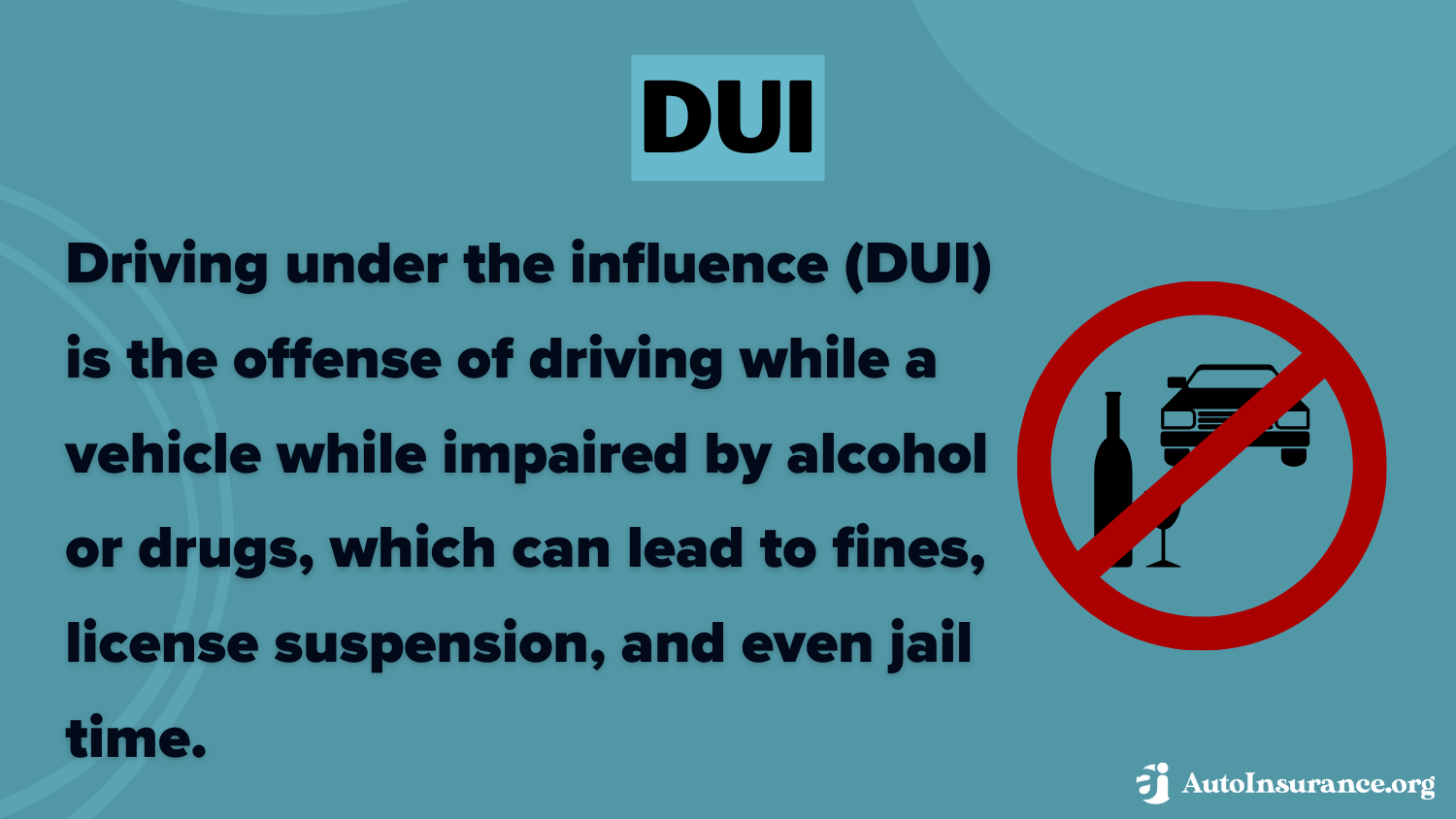
The legal limit for blood alcohol content (BAC) is 0.08%, but impairment can still occur at lower levels, especially with drugs. DUI charges carry serious consequences, including fines, license suspension, and possible jail time.
In addition, a DUI conviction can significantly increase your car insurance rates, with some drivers facing hikes of over 70%. DUI definition and its penalties vary by state, but the effects are far-reaching.
A DUI can impact your driving record, employment, and personal finances. If you’re dealing with a DUI or want to know how it affects your insurance, it’s essential to explore your options. Enter your ZIP code above to learn how a DUI can influence auto insurance premiums and coverage.
- DUI means driving under the influence of alcohol, drugs, or prescription meds
- DUI charges lead to fines, license suspension, and higher insurance rates
- A DUI conviction can stay on your record for years, impacting your future coverage
Definition of a DUI Charge
At its heart, a DUI charge means you were caught endangering yourself and others by driving while under the influence of drugs or alcohol. DUIs are a serious problem. In 2019, 10,142 people lost their lives to DUI. However, there is some good news.
Through concentrated efforts by the National Highway Traffic Safety Administration (NHTSA) and programs like Mothers Against Drunk Driving (MADD), DUIs in America are at an all-time low. Still, DUIs and DWIs plague America’s roads.
Although DUI consequences differ by state, the offense is defined consistently nationwide: a driver with a blood alcohol content (BAC) of 0.08 or higher is considered impaired. Ohio’s BAC of 0.08% or more also qualifies as “legally impaired.”
Read More: What is a DWI?
Free Insurance Comparison
Compare Quotes From Top Companies and Save
Understanding Blood Alcohol Content
In simple terms, BAC measures how much alcohol is in your bloodstream. This number is used to define DUI level or the level of intoxication legally. Your BAC is the number of grams of ethanol per 100 milliliters of blood. You’re legally considered intoxicated at a BAC of 0.08, but that doesn’t necessarily mean you’ll feel drunk.
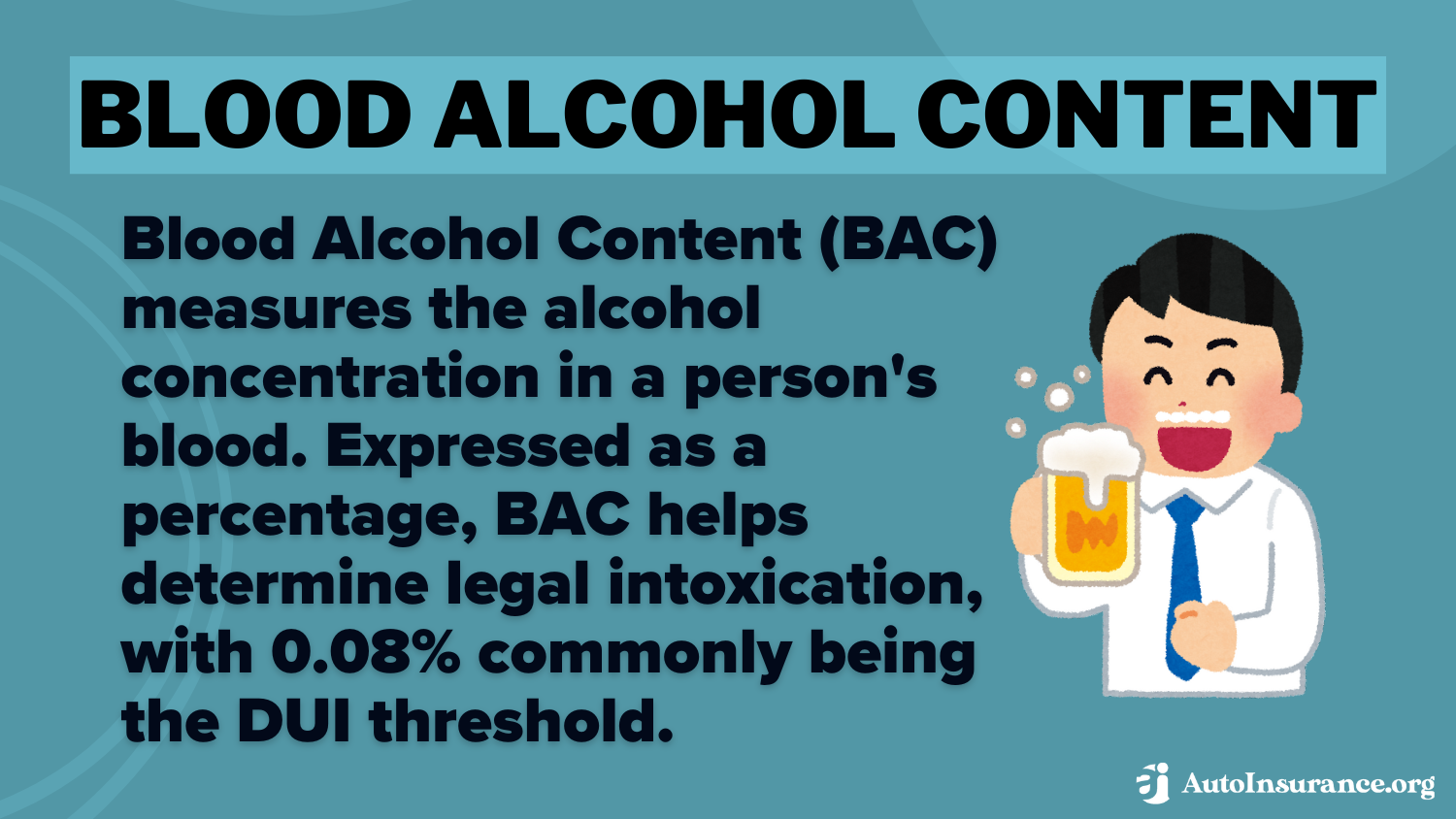
People experience drunkenness differently based on their tolerance and body, so it’s essential to know how many drinks will get you to a 0.08 BAC. If a cop pulls you over and finds you at the legal limit, they won’t care if you say you don’t feel drunk.
A standard drink adds around 0.02 to your BAC, meaning you’ll be legally drunk after four drinks. A standard drink includes:
- 12 ounces of beer
- 5 ounces of wine
- 5 ounces of liquor
There are a lot of myths out there about how to sober up quickly, including coffee, cold showers, or sports drinks. However, there is only one-way alcohol leaves your body: time. For every hour that passes, your BAC drops by about 0.015. That means that your body needs over an hour to process every alcoholic beverage you drink.
Read More: What an Alcohol Detection Systems Mandate Would Mean
Comparing DUI vs. DWI Severity
Although they mean different things (DWI stands for driving while impaired), they’re equally as bad. The main difference between DUI vs. DWI depends on your state. Some states don’t differentiate between the two, while others do.
For states that define them differently, a DWI is usually reserved for drug charges. In states with separate charges for DWI and DUI, DWI is generally the worst of the two. Some states allow first-time offenders to lower their DWI charges to a DUI. Others, like Texas, have zero tolerance and charge anyone over 21 with a DWI.
Even a first-time DUI offense can have lasting consequences, from fines to skyrocketing insurance rates. The financial impact extends far beyond the court date.Kristen Gryglik Licensed Insurance Agent
Other states use DUI to refer to reckless drivers under 0.08 BAC and reserve DWI for drivers over the legal limit.
Consequences of a DUI
The most common reason people get arrested is because of DUI. DUIs aren’t like regular traffic citations, like speeding tickets or stopping failures. A DUI can stay with you for years and affect several aspects of your life, including:
- Driver’s license suspension. You can lose your license over a DUI, sometimes on your first offense, for up to two years. That leaves you without transportation for work, school, errands, and other responsibilities.
- Employment. If your job requires you to drive and you lose your license, you won’t be able to work. Additionally, most driving jobs have rules about DUIs, even if you don’t lose your license.
- Background checks. A felony or misdemeanor DUI will show up in your background. It’s not just employers that do background checks – apartments, college financial aid applications, and school admissions also conduct these kinds of reviews.
- Insurance rates. Getting a DUI automatically makes you a high-risk driver, and you’ll pay for it when it comes to insurance. Some companies will terminate your coverage altogether. You can at least expect your rates to double or triple for several years.
Additionally, you’ll have a DUI on your driving record. Some states will remove DUIs from your history after a few years, while others are there for the rest of your life.
How Long a DUI Stays on Your Record
State DUI Record Duration
Alabama 5 years
Alaska Life
Arizona 5 years
Arkansas 5 years
California 10 years
Colorado 10 years
Connecticut 10 years
Delaware 5 years
Florida 75 years
Georgia 10 years
Hawaii 5 years
Idaho Life
Illinois Life
Indiana Life
Iowa 12 years
Kansas Life
Kentucky 5 years
Louisiana 10 years
Maine Life
Maryland 5 years
Massachusetts 10 years
Michigan 7 years
Minnesota 10 years
Mississippi 5 years
Missouri 10 years
Montana 5 years
Nebraska 12 years
Nevada 7 years
New Hampshire 10 years
New Jersey 10 years
New Mexico 55 years
New York 15 years
North Carolina 7 years
North Dakota 7 years
Ohio Life
Oklahoma 10 years
Oregon Life
Pennsylvania 10 years
Rhode Island 5 years
South Carolina 10 years
South Dakota 10 years
Tennessee Life
Texas Life
Utah 10 years
Vermont Life
Virginia 11 years
Washington 15 years
West Virginia 10 years
Wisconsin 10 years
Wyoming 10 years
Once a DUI falls off your record (if it does), you’ll probably be eligible for lower insurance rates, and the DUI will stop appearing on background checks.
Read More: How Auto Insurance Companies Check Driving Records
Free Insurance Comparison
Compare Quotes From Top Companies and Save
DUI Resulting in Death: Legal Terms
The worst-case scenario for a DUI involves the death of an innocent person. Unfortunately, thousands of families are affected by this tragedy every year. The penalty for accidentally killing someone during a DUI varies by state. Some states, such as California, might consider it a DUI murder. Others, like Arizona, don’t have specific rules in place.
In most states, accidental deaths are usually charged as either manslaughter, second-degree homicide, or criminally negligent homicide. Each state punishes accidental death differently:
Jail Time for Accidental Death After a DUI
State Minimum Jail Time Maximum Jail Time
Alabama 1 year 10 years
Alaska 3 years 99 years
Arizona 4 years 12.5 years
Arkansas 1 year 20 years
California 4 years 10 years
Colorado 2 years 24 years
Connecticut 2 years 20 years
Delaware 5 years 25 years
Florida 4 years 15 years
Georgia 3 years 15 years
Hawaii 2 years 10 years
Idaho 2 years 15 years
Illinois 3 years 28 years
Indiana 2 years 20 years
Iowa 2 years 25 years
Kansas 2 years 10 years
Kentucky 1 year 20 years
Louisiana 3 years 30 years
Maine 6 months 10 years
Maryland 2 years 20 years
Massachusetts 2.5 years 15 years
Michigan 2 years 15 years
Minnesota 3 years 10 years
Mississippi 1 year 25 years
Missouri 3 years 15 years
Montana 1 year 30 years
Nebraska 2 years 20 years
Nevada 2 years 20 years
New Hampshire 2 years 15 years
New Jersey 3 years 10 years
New Mexico 6 years 18 years
New York 5 years 15 years
North Carolina 2 years 25 years
North Dakota 2 years 20 years
Ohio 3 years 20 years
Oklahoma 1 year 15 years
Oregon 3 years 10 years
Pennsylvania 3 years 15 years
Rhode Island 5 years 20 years
South Carolina 3 years 25 years
South Dakota 2 years 15 years
Tennessee 3 years 15 years
Texas 2 years 20 years
Utah 2 years 15 years
Vermont 3 years 15 years
Virginia 5 years 20 years
Washington 4 years 15 years
West Virginia 3 years 20 years
Wisconsin 5 years 25 years
Wyoming 2 years 20 years
While some states have highly harsh sentences and drunk driving rates, it doesn’t necessarily mean a person will receive the harshest penalty. A judge will consider the circumstances of a DUI arrest and decide what they feel is suitable for that specific case.
Insurance Rate Increases After a DUI
On average, insurance prices go up by a staggering 74 percent after a DUI. That’s more than a speeding ticket and accident combined for your insurance. Consider the average monthly price of some of the biggest car insurance providers in the country before and after getting a DUI:
Company Average monthly price Average monthly price after DUI

$117 $245

$101 $260

$192 $281

$116 $161

$152 $194

$92 $178

$172 $238
Your best option is not to get a DUI. However, if you are in the unfortunate situation of a DUI, talk to your agent to see if they can help you save money.
Read More: Cheap Auto Insurance After a DUI
How to Find the Right Insurance After a DUI
Getting a DUI is incredibly stressful and potentially embarrassing. Of all the things you’ll need to take care of, insurance is one of the last things you’ll want to stress over. To save money, shop for quotes with as many companies as possible. Even if your current provider is willing to keep you as a customer, it might be cheaper to go elsewhere.
If you’ve answered, “What is a DUI?” the hard way, you can enter your ZIP code into our free tool to see what car insurance quotes might look like and the other factors that affect insurance rates.
Frequently Asked Questions
What is a DUI?
What does DUI stand for? DUI stands for Driving Under the Influence, indicating that a driver is impaired by alcohol or drugs while operating a vehicle.
How is DUI defined?
DUI refers to the act of operating a motor vehicle while under the influence of alcohol or drugs to the extent that it impairs the driver’s physical and mental abilities.
Can DUI also include driving under the influence of prescription medications?
Yes, DUI can include driving under the influence of prescription medications if they impair the driver’s ability to operate a vehicle safely. Following the prescribed dosage and any warnings regarding driving or operating machinery while taking medications is essential. For more information on how insurers handle impaired driving and drug use, read our article “Do auto insurance companies drug test?”
What are the typical blood alcohol concentration (BAC) limits for a DUI?
The specific BAC limits vary by jurisdiction, but in many places, a BAC of 0.08% or higher is considered legally impaired for adult drivers. However, lower BAC limits may apply to drivers under the legal drinking age or those operating commercial vehicles.
What is the most common penalty for a DUI?
The most common penalty for a DUI generally includes fines, license suspension, and mandatory DUI education classes. Depending on the case specifics, it may also involve community service or probation. For more on how a suspension impacts your coverage, read our article “Does a suspended license affect auto insurance rates?”
What is the best outcome for a DUI?
The best outcome in a DUI case would typically be a dismissal of charges or a reduced charge, potentially to a lesser offense like reckless driving, which may carry fewer penalties and have a lower long-term impact.
How long do most DUI cases take?
Most DUI cases take several months, but the duration varies. Some cases may resolve in a few weeks, while others can take a year or longer, depending on court availability, case complexity, and legal strategy. Read our article “When to Take Your Auto Insurance Company to Court” for advice on navigating legal actions.
What is the best plea for a DUI?
The best plea for a DUI depends on the case details. Pleading “not guilty” is often advised initially to explore defenses, though a plea agreement might be negotiated later for a reduced charge or penalty.
What is the best case for a DUI?
The best case for a DUI would involve a dismissal of charges, ideally due to insufficient evidence, improper procedures, or a successfully argued defense that undermines the prosecution’s case.
What is the best defense for a DUI?
Common DUI defenses include challenging the accuracy of breathalyzer or field sobriety tests, questioning the legality of the traffic stop, or presenting evidence that the driver was not impaired. It’s essential to understand how a DUI conviction could affect your insurance rates — enter your ZIP code below to determine how it can impact your premiums and coverage options.
What is the highest DUI limit?
How long does a DUI stay on your record in the U.S.?
What is the highest punishment for reckless driving?
What is the highest a DUI can cost?
What is a high-range DUI?
What is the most common sentence for a first DUI?
How long do you go to jail for reckless imprudence?
Related Articles
-
Oct 2024

Best Windshield Replacement Coverage in Indiana (Top 10 Companies in 2026)
-
Apr 2025
How to Cancel Ameriprise Auto Insurance in 2026 (6 Easy Steps)
-
Oct 2024
The Three-Tire Rule Defined (2026)
-
Mar 2025

Best Windshield Replacement Coverage in California (Top 10 Companies in 2026)
-
Aug 2026
Can my auto insurance company sue me?
-
May 2026
Does car insurance cover a hit-and-run?






Get a FREE Quote in Minutes
Insurance rates change constantly — we help you stay ahead by making it easy to compare top options and save.