Companies Creating Self-Driving Cars (2026)
Companies like Tesla and Waymo are developing autonomous vehicles that may be the wave of the future. Learn where the technology stands and what might be coming soon.






Table of Contents
Table of Contents

Insurance and Finance Writer
Merriya Valleri is a skilled insurance writer with over a decade of professional writing experience. Merriya has a strong desire to make understanding insurance an easy task while providing readers with accurate and up-to-date information. Merriya has written articles focusing on health, life, and auto insurance. She enjoys working in the insurance field, and is constantly learning in order to ...
Merriya Valleri

Licensed Insurance Broker
Zach Fagiano has been in the insurance industry for over 10 years, specializing in property and casualty and risk management consulting. He started out specializing in small businesses and moved up to large commercial real estate risks. During that time, he acquired property & casualty, life & health, and surplus lines brokers licenses. He’s now the Senior Vice President overseeing globa...
Zach Fagiano
Updated October 2024
The autonomous vehicle (AV) industry has been working hard for more than a decade to make self-driving cars a reality.
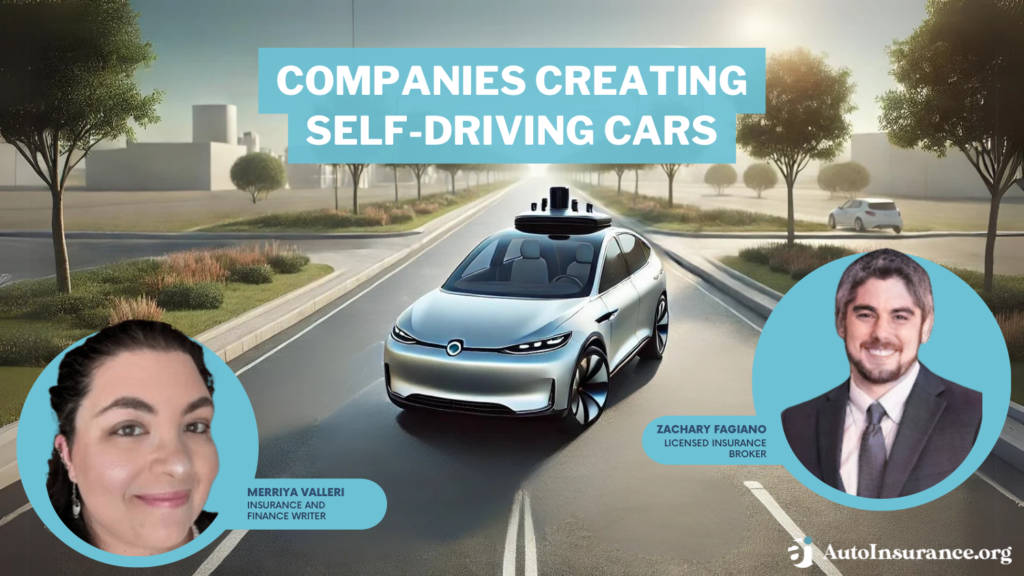
Thanks to the research, development, hours of safety testing, and investments of billions of dollars, self-driving taxis and commercial delivery vehicles are already a thing of the present in certain places in the U.S. and China. There are currently 38 states with autonomous driving laws on the books. From establishing exploratory commissions to permitting driverless road testing, legislatively the way is already being paved for self-driving cars. We haven’t reached the stage where you can simply visit a dealership and purchase a self-driving car that drives itself off the lot. However, numerous forward-thinking companies around the globe are committed to making personal self-driving vehicles available to everyday car owners. The competition is fierce in this sector, but these ten leading self-driving software companies are at the forefront of advancing autonomous vehicle technology and shaping the market. Among them, Acura’s self-driving car models and various companies specializing in self-driving technology are making significant strides.
- Self-driving cars operate on public roads today, providing ride-hailing and commercial delivery services, but personal self-driving cars are unavailable
- The 10 companies making autonomous vehicles a reality include a mix of automobile manufacturers and tech companies designing the hardware, software, and other self-driving programs and platforms
- With billions of dollars invested in autonomous vehicle testing, research and development, manufacturing, and strategic partnerships, self-driving cars for the masses will likely be a reality soon
Waymo
Waymo is the Old “G” of the autonomous vehicle industry. The company, which began as the Google Self-Driving Car Project, cut its teeth in an innovation incubator in 2009 and has been a leader in autonomous car technology ever since.
Alphabet Inc., an American multinational technology conglomerate holding company, owns Waymo and partners with Chinese automaker Geely.
In 2012, Waymo became the first company to road test a Level 3 autonomous vehicle. Today, its autonomous cars have driven over 20 million miles on public roads.
Waymo introduced its robo-taxi service in 2019 and now manages a fleet of 600 vehicles in Phoenix, Arizona, making it one of the largest companies in the autonomous vehicle sector. This fleet features some of the top semi-autonomous cars and offers driverless cars available in Phoenix.
Considering how long it’s been in the game and that it recently raised $2.5 billion in 2020, Waymo has earned major player status in the AV industry.
Tesla
For years, Tesla has dominated the electric vehicle market, and the company aims to extend this success to autonomous vehicles through Tesla’s Robotaxi Initiative. With hopes of setting a new standard for autonomous driving, Tesla is striving to offer the best self-driving car available. The Public Utilities Commission’s involvement will be crucial in shaping the future of this technology.
Tesla has recently concentrated on advancing the Tesla Autopilot, a vehicle boasting one of the most sophisticated semi-autonomous driving systems globally. This technology, developed by one of the leading companies producing self-driving cars, includes features such as adaptive cruise control, automatic navigation, auto-steering, lane changes, and valet parking from both parking spaces and garages. Additionally, it offers lane departure warnings and traffic light/stop sign recognition. As a brand offering self-driving cars, Tesla is at the forefront among companies developing autonomous vehicles.
Tesla’s founder, Elon Musk, is an undeniable visionary, and for many, Tesla represents the future of carmaking. Based on its leading AV technology and car manufacturing systems, the company is more than capable of starting an autonomous vehicle takeover and bringing self-driving cars to the masses.
Aurora
Aurora is a self-driving vehicle company founded by the former head of Google’s self-driving car project, Chris Urmson; former head of Tesla Autopilot, Sterling Anderson; and former head of Uber’s Advanced Technology Group, Drew Bagnell.
Aurora has its genesis with Uber, acquiring its self-driving unit, the Advanced Technologies Group, in 2020. Aurora acquired the group’s 1,200-person team, along with $400 million of investment from Uber. Aurora also has solid financial backing from Amazon.
Aurora aims to advance the advantages of self-driving technology—safely, swiftly, and extensively. As an AI-driven car company, its culture stands out with core values such as “no jerks” and “set outrageous goals.” Aurora is dedicated to enhancing all types of self-driving cars and remains a prominent brand among autonomous vehicle companies.
Aurora occupies the same self-driving tech platform space in the AV industry as Argo AI and Baidu’s Apollo. Aurora remains a leader in developing driving systems for AVs used in long-haul trucking, ride-hailing, and commercial goods delivery.
Like many other key players in autonomous vehicles, their goal is to adapt their auto-driver hardware and software across various automobile types, makes, and models, including those for personal vehicle use. This approach is part of their effort to develop the best software for autonomous driving and integrate autopilot features into different brands.
GM’s Cruise
Cruise started in 2013 after successfully participating in a startup accelerator program. It only took three years before GM bought Cruise Automation for $1 billion to continue working on fully autonomous cars, meaning no steering wheels or pedals.
Cruise initially adapted autonomous technology onto the Chevy Bolt platform. However, in 2020, the company introduced the Cruise Origin, a fully driverless vehicle designed without traditional steering controls and with 40% of its hardware dedicated to self-driving capabilities. During that same year, Cruise began testing these completely autonomous vehicles in San Francisco, California. This move highlights Cruise’s role among manufacturers of autonomous vehicles and underscores its position as a significant player in the realm of top stocks in autonomous driving technology. Additionally, the Cruise Origin is one of the best electric cars with self-driving capabilities.
Cruise’s success is due in large part to its partnership with GM, a longtime frontrunner in the AV industry. In fact, it was GM – not Ford, Uber, or Waymo – that was the first company to seek permission from the US DOT to operate fully autonomous cars for commercial ride-hailing service.
As for Cruise’s future, there’s nothing but open roads ahead. Cruise recently announced plans to mass-produce the Origin driverless shuttle vehicle in 2023.
Ford’s Argo.ai
Argo.ai doesn’t make cars — it makes the self-driving technology that goes into them. They linked with Ford in February 2017, when the auto giant invested $1 billion in the then-new robotics and artificial intelligence company.
Argo.ai aims to design a fully integrated self-driving technology platform for automakers to incorporate into their AV manufacturing.
In addition to Ford, Argo.ai has attracted investments totaling $2.6 billion dollars from Volkswagen in 2019.
In 2021, Argo.ai and Ford partnered with Walmart to launch a driverless delivery service. This year, Argo.ai started testing driverless operations in Miami and Austin. The service is limited to daytime hours and will only be operated by company employees using an internally developed app.
Baidu’s Apollo
Baidu is a Chinese multinational technology company specializing in internet-related services and artificial intelligence. Baidu’s started an autonomous driving unit in 2017 called Apollo.
Baidu’s Apollo is an open-source platform designed for autonomous vehicles, offering a range of services including cloud data, software, hardware, testing tools, and more for electric cars with self-driving capabilities. Apollo’s autonomous system leverages Baidu’s extensive datasets and real-world driving data to test and refine their algorithms, contributing to advancements in technology. As one of the largest companies in the autonomous vehicle industry, Baidu is a prominent player among tech companies developing driverless car fleets.
Baidu had a big year in 2019. It became one of three AV companies to secure a commercial license in China for self-driving buses. It also launched a robo-taxi service, Apollo Go, for the general public in Hunan, China. Now, Apollo Go is available in ten Chinese cities and has provided 196,000 rides just in Q1 of 2022.
According to the company’s co-founder, Robin Li, Baidu’s goal is to expand Apollo Go’s self-driving taxi service to 65 cities by 2025 and 100 cities by 2030.
Pony.ai
Pony.ai is a Chinese self-driving vehicle company that galloped on the AV scene in 2016. Pony.ai focuses on developing full self-driving ridesharing services. The California company was permitted to begin autonomous vehicle testing on public roads within three months of being founded.
Pony.ai is a company of many firsts. Out of all of the AV companies, Pony.ai was the first to launch a robo-taxi service in December 2018 in limited regions of California and Beijing.
In 2022, Pony.ai became the first AV company to obtain a robo-taxi license in China.
However, not all of Pony.ai’s firsts are good.
In 2021, Pony.ai had the unenviable distinction of being the first company to have its driverless testing permit suspended by the California DMV after one of its driverless vehicles hit a road center divider and a traffic sign after making a right turn.
Five months after the accident, the National Highway and Traffic Safety Administration issued its first recall to Pony.ai about the automated driving system involved in the incident.
Finally, in May 2022, California’s DMV revoked Pony.ai’s testing permit for failing to monitor driving records properly.
However, don’t count Pony.ai out. The company has investor support from big venture capitalists and deep-pocket auto industry investors, like Toyota. The company was recently valued at over $5 billion.
Aptiv and Hyundai’s Motional
Motional debuted in March 2020 as a joint venture formed by Hyundai Motor Group and Aptiv, a leading self-driving technology company claiming to be the only provider of autonomous cars’ brains (software and compute) and nervous system (power and data distribution).
Motional is a mashup of the word “motion,” which speaks to the movement of driverless vehicles in particular and the AV industry in general, and the word “emotional,” representing the feeling of safety and reliability the company wants to impart.
Since 2020, the company has been offering autonomous ride-hailing services in Las Vegas, with a 98% 5-out-of-5 passenger experience rating. In 2021, Motional became the first company to operate multiple driverless vehicles on public roads.
This year, Motional announced a pilot program with UberEats to deliver meals from select Santa Monica, California restaurants. Motional’s mission is to develop and commercialize high-performing self-driving vehicles for the masses, and it appears to be on its way to doing so.
AutoX
AutoX was founded in 2016 by Dr. Jianxiong Xiao, a former assistant professor at Princeton University known as Professor X. Alibaba Group Holding owns AutoX, and its headquarters is in Shenzhen, China.
In 2019, AutoX received the second driverless robo-taxi permit from California after Pony.ai.
Today, AutoX has the notoriety of operating the largest robo-taxi fleet in China. It is also the only company in China using fully driverless robo-taxis on public roads.
AutoX has the largest driverless auto engineering team in China. Its five research and development centers in China and the U.S. help keep the company’s AV innovation cutting-edge.
Having raised over $160 million to date, the company has plenty of funding in its coffers to continue to grow and achieve its objective of leading the AV revolution in the biggest market in the world: China.
Optimus Ride
Finally, there’s Optimus Ride, an autonomous vehicle company providing fully automated shuttle services within restricted, geofenced communities. Based in Boston, Optimus Ride is owned by Magna International, a Canadian firm specializing in car mobility technology. The company is among those focused on maintaining the confidentiality of safety details for robotaxis.
In March 2021, Optimus Ride joined forces with Polaris, a company that manufactures the low-speed GEM electric car using Optimus Ride’s AV software and hardware technology.
There are approximately 30 Polaris GEM electric cars in New York, California, Virginia, and Massachusetts outfitted with Optimus Ride’s AV systems. There’s no sign of the Optimus Ride and Polaris duo slowing down. In fact, they have plans to start offering fully autonomous GEM vehicles to the public market by the second half of 2023.
Bottom Line: Self-Driving Vehicles Are Here, and More Are Coming
An increasing number of companies are vying to become leaders in the autonomous vehicle sector. While some have been in the game since the technology’s early days, others are newer entrants. Despite their varied backgrounds, these companies share a common goal: to transform and bring to market cars with the best self-driving features for widespread use. Among them, the top 10 companies in self-driving car technology are striving to revolutionize the industry and make driverless vehicles accessible to the masses.
The ten companies listed above have done a lot to advance AVs in the ride-hailing and commercial delivery sectors. They plan to keep the pedal to the metal until self-driving cars are a reality for the mainstream public.
Frequently Asked Questions
What are self-driving cars?
Self-driving cars, also known as autonomous vehicles, are vehicles equipped with advanced technologies and artificial intelligence systems that enable them to navigate and operate without human input. These cars use sensors, cameras, radar, and other technologies to perceive their environment, interpret data, and make decisions to control the vehicle’s movement.
Which companies are involved in creating self-driving cars?
Several prominent companies are actively engaged in developing self-driving car technology. Some notable players in the field include:
- Waymo (owned by Alphabet Inc., the parent company of Google)
- Tesla
- Cruise (a subsidiary of General Motors)
- Uber (partnering with various companies for self-driving technology)
- Apple (Project Titan)
- Ford (partnering with Argo AI)
- Baidu (Apollo program)
- Nvidia (providing AI computing platforms for autonomous vehicles)
- Mobileye (an Intel subsidiary)
What progress has been made in self-driving car technology?
Significant progress has been made in self-driving car technology over the years. Companies have conducted extensive research, testing, and development to improve the safety and reliability of autonomous vehicles. Self-driving cars have already demonstrated the ability to navigate various road conditions, interpret traffic signals, and avoid obstacles. However, the technology is still evolving, and further advancements are being made to enhance its capabilities.
Are self-driving cars available for purchase?
While self-driving car technology is rapidly advancing, fully autonomous vehicles available for public purchase are not yet widely available. Most companies are currently focused on developing and testing self-driving technology, and some offer limited pilot programs or early access to selected customers. However, traditional car manufacturers and technology companies are actively working towards bringing self-driving cars to market in the near future.
Are self-driving cars safe?
Safety is a top priority for companies developing self-driving cars. Autonomous vehicles undergo rigorous testing and evaluation to ensure their safety before they can be deployed on public roads. While accidents involving self-driving cars have occurred during testing, the data suggests that autonomous vehicles have the potential to significantly reduce accidents caused by human error. Companies are continually refining the technology and collaborating with regulators to establish safety standards for self-driving cars.
How will insurance work for self-driving cars?
The insurance landscape for self-driving cars is still evolving. Insurers are actively studying and adapting to the challenges posed by autonomous vehicles. Factors such as liability, accident rates, and data collection play a crucial role in determining insurance premiums. As the technology matures and regulations are established, insurers will likely develop specialized insurance products tailored to self-driving cars, which may include considerations for both traditional coverage and product liability for the technology involved.
What car brands have self-driving cars?
Several car brands are at the forefront of self-driving technology, including Tesla, Waymo (a subsidiary of Alphabet Inc.), Cruise (owned by General Motors), and Argo AI (backed by Ford and Volkswagen). Additionally, companies like BMW, Mercedes-Benz, and Audi are actively developing and testing autonomous driving systems.
Which companies make self-driving cars?
Major companies involved in manufacturing or developing self-driving cars include Tesla, Waymo, Cruise, Argo AI, and Aurora. Traditional automakers such as General Motors, Ford, and Volkswagen are also heavily invested in autonomous vehicle technology.
Who makes autonomous vehicles?
Autonomous vehicles are made by a combination of tech companies and traditional automakers. Notable manufacturers include Waymo, Cruise, Argo AI, Aurora, Tesla, and companies like Baidu and Nvidia, which provide essential technology and software for autonomous driving systems.
How are self-driving cars made?
Self-driving cars are made through a combination of advanced hardware and software. Key components include sensors (cameras, radar, and lidar), powerful computing systems, and sophisticated algorithms for machine learning and artificial intelligence. These components work together to enable the vehicle to perceive its environment, make decisions, and drive autonomously.
How many companies make self-driving cars?
How many self-driving cars are on the road?
What are self-driving cars?
Which brands have self-driving cars?
Which cars have autonomous driving features?
What is a robotaxi?
What is the cheapest self-driving car?
When will self-driving cars be available?
Which cars have the best self-driving features?
Who is developing self-driving cars?
Who has the best autonomous driving technology?
What are the 10 benefits of self-driving cars?
What are some autonomous vehicle companies in the USA?
What happened after the commission with Waymo and Cruise in San Francisco?
Where can you find driverless cars in California?
What are the top 5 autonomous driving companies?
Can I purchase a Waymo car?
Related Articles
-
Jun 2025

Drunk Driving Rates by State [+ Coronavirus DUI Drops]
-
Dec 2024
Safest Highways by State (2026)
-
Jul 2024
Best Children’s Audiobooks for Road Trips (2026)
-
Dec 2024
Could you pass a driving test?
-
Oct 2024
Longest Emergency Room Wait Times by State (2026)
-
Jan 2025
Highest Paying Cities for Young Workers (2026)





Get a FREE Quote in Minutes
Insurance rates change constantly — we help you stay ahead by making it easy to compare top options and save.