

Can I get my car out of impound without insurance?
In most cases, you will not be able to get your car out of impound without insurance. There are a few states, such as Virginia, that may only require you to pay a fee to retrieve your car. Learn how to get your vehicle out of impound.
Read more





Table of Contents
Table of Contents

Professor & Published Author
D. Gilson is a writer and author of essays, poetry, and scholarship that explore the relationship between popular culture, literature, sexuality, and memoir. His latest book is Jesus Freak, with Will Stockton, part of Bloomsbury’s 33 1/3 Series. His other books include I Will Say This Exactly One Time and Crush. His first chapbook, Catch & Release, won the 2012 Robin Becker Prize from S...
D. Gilson, PhD

Licensed Insurance Agent
Heidi works with top-rated insurance carriers to bring her clients the highest quality protection at the most competitive prices. She founded NoPhysicalTermLife.com, specializing in life insurance that doesn’t require a medical exam. Heidi is a regular contributor to several insurance websites, including FinanceBuzz.com, Insurist.com, and Forbes. As a parent herself, she understands the need ...
Heidi Mertlich
Updated December 2024
If the authorities have towed your car and it’s currently in an impound lot, you’ll want to know the next steps for getting your car back. There are specific requirements you will need to meet before you can retrieve your vehicle, depending on why it was impounded in the first place.
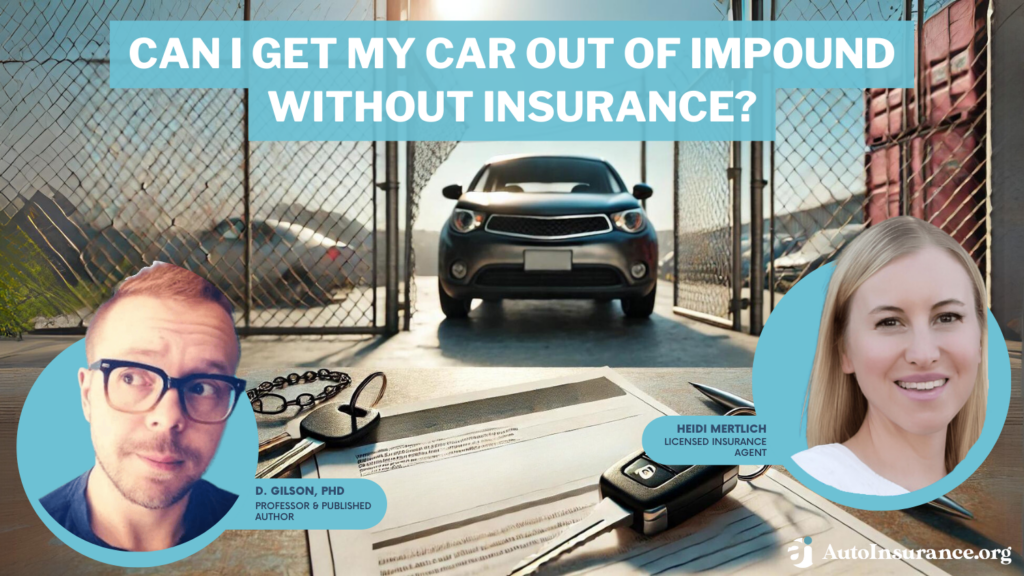
You may want to know how to get your car out of impound without insurance. We can help. One of those requirements will probably be to provide proof of car insurance on said vehicle. So what if you don’t have active car insurance? Can you get your car out of impound without insurance? Read on to learn more.
You don’t want to find yourself in a situation where you have your car impounded with no insurance. Make sure you’re properly insured in case you ever have to deal with vehicle impoundment. Avoid impoundment by finding the auto insurance that’s right for you. Just enter your ZIP code to begin.
- The police have the right to impound your car in certain circumstances
- Typically, you won’t be able to retrieve the vehicle without showing proof of insurance
- You also won’t be able to get your vehicle out of impound without paying a fee
Can I get my car out of impound without insurance?
While the rules will vary by state, the police may have the right to impound your car in certain circumstances. This may be due to criminal activity, such as driving with a suspended license or DUI, or if you have frequently violated traffic laws.
The majority of states insist you cannot drive a vehicle on the road without a minimum level of insurance. So, if the police stop your vehicle and you cannot provide evidence of adequate insurance, they might seize it and send it to an impound lot. That means that yes, you can have your car towed for no insurance.
So then you might wonder, do I need insurance to get my car out of impound? Because of these laws, you’ll typically have to show proof of insurance to retrieve your car. The impound lot operator will usually need to confirm your coverage before they can hand back your keys.
However, there are some exceptions, and there are steps for how to get a car out of impound without insurance. According to the Virginia DMV, you may not need to have minimum insurance but can pay an uninsured motor vehicle (UMV) fee instead. If you live in Virginia, you should check with the impound lot about your specific situation.
The Centers for Disease Control (CDC) reports that there are 22 states with vehicle impoundment laws on the books (though your vehicle can be impounded regardless of where you live). Take a look at this table to see a summary of the CDC’s data.
Vehicle Impoundment and Confiscation Laws by State
| State | Vehicle Impoundment and Confiscation Laws |
|---|---|
| Alabama | A vehicle may be impounded if a driver is found to be driving with a revoked license or driving with a license suspended because of a DWI-related offense or refuses a breath test. However, the law provides that the vehicle will be released to the registered owner if the offender is not the owner. Further, police can release the vehicle, rather than impounding it, if it is determined that the driving is due to an emergency. This law does not seem to be aimed at long-term prevention of drinking and driving by separating offenders from their vehicles. |
| Alaska | The municipalities may enact ordinances to impound or confiscate motor vehicles for violations of local DWI offenses or refusal of chemical test laws for first and subsequent offenses. However, these laws are not mandatory. |
| Arizona | Under Arizona’s temporary vehicle impoundment law, the offender’s vehicle may be immediately impounded for 30 days if the driver is arrested for any of the following offenses: (1) DWR for any reason; (2) DWS where the suspension was based on driving under the influence; (3) DWS where the suspension was based on a drunk-driving offense; or (4) DWS where the suspension was based on the frequency of traffic law violation convictions. The vehicle may be released before 30 days if the offender’s driving privileges have been reinstated or if the offender’s spouse enters a five-year agreement with the state to not to allow an unlicensed driver to operate the vehicle. |
| California | California has two vehicle impoundment laws. The first law states that a vehicle owned and driven by an offender may be impounded up to 30 days for a first or second DWI offense and up to 90 days for third and subsequent offenses, if the offense is committed within five years of a prior offense. This first law prevents the vehicle from being impounded if it is the only vehicle available to the family or if another person has a community-property interest in the vehicle. The second law states that the vehicle owned and driven by the offender may be impounded for up to six months for a first DWI offense and up to 12 months for a subsequent DWI offense. We found no information on reasons one law might be enforced rather than the other. There is no mention of laws concerning chemical test refusals. |
| Connecticut | Connecticut has a vehicle impoundment law. The vehicle may be impounded for refusing a chemical test, which is a criminal offense and a felony DWI for a third or subsequent DWI offense. An ALR suspension counts as a prior DWI offense. There is also limited vehicle impoundment of 48 hours if a driver is arrested for drinking and driving with a suspended or revoked license. This law seems intended to prevent the offender from operating the vehicle immediately after the drinking-and-driving offense, rather than being aimed at long-term prevention of drinking and driving by offenders. |
| Washington D.C. | The District of Columbia also has a limited vehicle impoundment law, under which impoundment is limited to 24 hours. However, the vehicle may be released to a legally licensed driver. |
| Florida | Florida has a vehicle impoundment law, under which the vehicle that is used and owned in a first DWI offense may be impounded for ten days. This action may not be concurrent with probation or imprisonment. For a second DWI offense within five years, the vehicle can be impounded for 30 days and, for a third DWI offense within ten years, for 90 days. This applies to all vehicles owned by the offender and may not be concurrent with probation or imprisonment. However, unlike first DWI offenses, it must be concurrent with the driver’s license revocation. For first, second, and third DWI offenses, these actions are conditions of mandatory probation; however, the court may decide not to order vehicle impoundment if the family has no other means of transportation. There also is a limited vehicle impoundment law for a DWI offense if, at the time of the DWI offense, the offender was driving with a license suspended for a prior DWI offense. This law seems intended to prevent the offender from operating the vehicle immediately after the drinking-and-driving offense, rather than being aimed at long-term prevention of drinking and driving by offenders. |
| Illinois | If the DWI offender is the registered owner, then the vehicle can be impounded for 24 hours for a second DWI offense or 48 hours for a third DWI offense. The vehicle may be released sooner to a competent, licensed driver with the owner’s consent. There also is a limited vehicle impoundment law, under which law enforcement can impound a driver’s vehicle for not more than 12 hours following a DWI arrest. Limited impoundment may be used if the officer reasonably believes that the arrested offender will commit another DWI offense if released. This law seems intended to prevent the offender from operating the vehicle immediately after the drinking-and-driving offense, rather than being aimed at long-term prevention of drinking and driving by offenders. |
| Iowa | For a second or subsequent DWI offense, the vehicle owned and used by the offender can be impounded or immobilized and the license plate seized (and registration confiscated if the vehicle is in custody) by law enforcement authorities. New registration plates are issued only at the end of the driver’s license revocation period or 180 days, whichever is longer. |
| Kannsas | For DWI violations, judges, at their discretion, may order vehicle impoundment or immobilization of the vehicle used in the offense, for up to one year. The offender pays all costs. Judges must take into account hardship to family. This law went into effect on July 1, 2003. |
| Maine | Maine also has a temporary vehicle impoundment law. The vehicle used in a DWI offense or for DWS for a prior DWI offense may be seized; however, the vehicle may be released after eight hours. This law seems intended to prevent the offender from operating the vehicle immediately after the drinking-and-driving offense, rather than being aimed at long-term prevention of drinking and driving by offenders. |
| Maryland | The vehicle can be impounded or immobilized (by suspending license plates) for not more than 180 days if the driver’s license is currently suspended for a prior alcohol offense. |
| Minnesota | Under Minnesota’s vehicle impoundment law, a vehicle may be impounded after a DWI arrest and released to the vehicle owner with proof of a valid driver’s license and insurance. This law seems intended to prevent the offender from operating the vehicle immediately after the drinking-and-driving offense, rather than being aimed at long-term prevention of drinking and driving by offenders. |
| Mississippi | For a second or subsequent DWI offenses, all vehicles owned by the offender must be impounded or immobilized at the time of conviction and remain so until the license suspension has expired. If any other person must use the vehicle, an ignition interlock may be required as an alternative to impoundment or immobilization. |
| Missouri | Missouri has a vehicle impoundment or vehicle forfeiture law; however, under Missouri law, cities with populations higher than 100,000 can make their own vehicle impoundment or forfeiture laws. The state law applies to the vehicle operated by the offender regardless of ownership; consequently, the vehicle is subject to impoundment or forfeiture if the driver has had one or more DWI offenses, including illegal per se. The vehicle also can be impounded or forfeited if the offender is driving with a license suspended for a prior DWI offense or for a DWI and involuntary manslaughter offense. Last, the vehicle can be impounded or forfeited if the driver has had two or more DWI offenses (including illegal per se) and, for either offense, had a BAC of 0.08 or greater (0.02 or greater for those under 21) or if the driver has refused to submit to a chemical test under the implied-consent law. |
| Nebraska | An offender who is driving with a license suspended for a prior DWI or an implied-consent conviction may have his or her vehicle impounded for not less than ten days and not longer than 30 days. An offender under 21 may have his or her vehicle impounded if he or she has a BAC of 0.02 or greater. |
| New Jersey | According to Century Council (2003), New Jersey has a vehicle impoundment law under which an offender’s vehicle must be impounded for 12 hours at the time of arrest. This law seems intended to prevent the offender from operating the vehicle immediately after the drinking-and-driving offense, rather than being aimed at long-term prevention of drinking and driving by offenders. NHTSA (2003a) does not report any vehicle impoundment laws in New Jersey, which raises a question as to which source is correct. |
| New Mexico | New Mexico also has a vehicle immobilization law, under which a vehicle may be immobilized for 30 days if the offender was driving with a revoked license, unless immobilization poses a hardship to the family. |
| Oregon | Vehicle impoundment or immobilization is limited to one year for a second or subsequent DWI offense or for driving with a suspended license. This action is at the court’s discretion and applies to all vehicles owned and used by the offender, even if not used in the offense. The offender must pay the costs of removing, storing, or immobilizing the vehicle. |
| Virginia | Any vehicle used in a DWI offense may be impounded or immobilized for 30 days if the offender was driving with a license suspended because of a prior DWI, an administrative per se violation, or chemical test refusal. In addition, vehicles owned by an offender may be impounded or immobilized for up to 90 days even if the vehicles were not used in the offense. There are family hardship exceptions for households with only one vehicle. |
| Washington | Washington has a vehicle impoundment law. In addition to impounding the vehicle for other possible penalties for driving with a license suspended for a prior DWI conviction, authorities may also impound the vehicle for not more than 30 days on a first offense. For a second offense, the vehicle may be impounded for not more than 60 days or, for a third offense, not more than 90 days. |
| Wisconsin | There is a policy in Wisconsin that allows temporary vehicle impoundment, as part of the immobilization process. This is not a law, just a policy, and is used only temporarily and at the discretion of officers in the field. |
| Wyoming | Wyoming has a policy that allows for temporary vehicle impoundment. An offender’s vehicle may be impounded following an arrest if a sober driver is unavailable. This law seems intended to prevent the offender from operating the vehicle immediately after the drinking-and-driving offense, rather than being aimed at long-term prevention of drinking and driving by offenders. |
Free Insurance Comparison
Compare Quotes From Top Companies and Save
What happens if the police impound your car because you don’t have insurance?
But you may ask, can my car get impounded for no insurance? Yes, the police may decide to impound your vehicle if you drive without insurance. The laws vary by state, but you’ll undoubtedly want to avoid this situation since having your car impounded for no insurance can be costly, including fines for being uninsured and fees for getting your car out of impound without insurance.
So, to review — can the police tow your car for no insurance? Yes. Can police impound your car for no insurance? Again, yes.
If you don’t want your car seized by the police for no insurance, be prepared. Always carry at least the minimum auto liability insurance to meet state requirements and have your insurance card with you while you drive. You may need to produce it along with your registration and title if a law enforcement officer stops you.
Remember that you may be fined or have your car impounded if you don’t have these documents in your vehicle.
And now the question is, what happens if your car is impounded by police? Keep reading to find out what to do if you’ve had your car impounded by the police for no insurance.
How can you get your car out of impound?
So, now you need to answer, what do I need to get my car out of impound? Some drivers may also ask, do you need proof of insurance to get your car out of impound? If you want to retrieve your car, you will typically have to go through a specific process. You’ll need to contact the impound lot for details so you can gather documentation before you show up.
You will likely need to provide the following:
- Vehicle title or registration
- Your photo ID
- Payment to settle the impound company’s fees
- Auto insurance on the vehicle, in most cases
You’ll want to act quickly, as it’s not cheap to keep a vehicle impounded. Keep that in mind if you are delaying purchasing insurance to get a car out of impound. But how much does it cost to get a vehicle out of impound?
What’s the cost to get a vehicle out of impound?
When your have an impounded car, how much does it cost to get it out? The cost to get your vehicle out of impound will vary. You will need to talk with the specific lot operator to determine how much you will have to pay.
The impounded car cost may include towing fees, daily storage charges, and a fee for releasing the vehicle. Since many factors are at play, the costs vary widely but could be up to $1,000. So when your car gets impounded, how much does it cost to get it out? It really depends on several factors, so there’s no set number.
You may be fined or have the vehicle you’re driving impounded if you don’t have these documents proving you have insurance. However, if you’re wondering does insurance cover impound fees, the answer is typically no. Even if you’re involved in an accident through no fault of your own, you can face a range of penalties.
Driving Without Auto Insurance by State & Offense
| State | First Offense | Second Offense |
|---|---|---|
| Alabama | Fine up to $500; registration suspension with $200 fee | Fine up to $1,000; six-month license suspension with $400 fee |
| Alaska | License suspension for 90 days | License suspension for one year |
| Arizona | Fine $500+; license/registration suspension for three months | Fine $750+; license/registration suspension for six months |
| Arkansas | Fine $50-$250; suspended registration until proof of insurance | Fine $250-$500; suspended registration until proof of insurance |
| California | Fine $100-$200; car may be impounded | Fine $200-$500; car may be impounded |
| Colorado | Fine $500+; license suspension until proof of insurance | Fine $1,000+; four-month license suspension |
| Connecticut | Fine $100-$1,000; one-month suspension with $175 fee | Fine $100-$1,000; six-month suspension with $175 fee |
| Delaware | Fine $1,500+; six-month license suspension | Fine $3,000+; six-month license suspension |
| Florida | License suspension until reinstatement fee is paid; $150 fee | License suspension until reinstatement fee is paid; $250 fee |
| Georgia | Suspended registration; $25 lapse fee and $60 reinstatement fee | Suspended registration; $25 lapse fee and $60 reinstatement fee |
| Hawaii | $500 fine or community service; three-month license suspension | $1,500 fine; one-year license suspension |
| Idaho | Fine $75; license suspension until proof of insurance | Fine up to $1,000; six-month license suspension |
| Illinois | License plate suspension until $100 reinstatement fee paid | Four-month license plate suspension with $100 fee |
| Indiana | License suspension for 90 days to one year | One-year license suspension within three years |
| Iowa | Fine $500 if in accident; $250 otherwise | NA |
| Kansas | Fine $300-$1,000; license suspension | Fine $800-$2,500; license suspension |
| Kentucky | Fine $500-$1,000; one-year license suspension | Fine $1,000-$2,500; one-year license suspension |
| Louisiana | Fine $500-$1,000; license suspension for 180 days if in accident | NA |
| Maine | Fine $100-$500; license suspension until proof of insurance | NA |
| Maryland | Loss of plates and registration; penalty fees | NA |
| Massachusetts | Fine $500-$5,000; one-year license suspension | License suspension for one year |
| Michigan | Fine $200-$500; 30-day license suspension | NA |
| Minnesota | Fine $200-$1,000; license suspension up to 12 months | NA |
| Mississippi | Fine $1,000; one-year license suspension | NA |
| Missouri | License suspension until $20 reinstatement fee paid | 90-day license suspension with $200 fee |
| Montana | Fine $250-$500; up to 10 days imprisonment | Fine $350; up to 10 days imprisonment |
| Nebraska | License suspension; $50 reinstatement fee | NA |
| Nevada | Fine $250-$1,000; registration suspension with $250 reinstatement fee | Fine $500-$1,000; registration suspension with $500 fee |
| New Hampshire | No mandatory insurance; SR-22 may be required after a conviction | NA |
| New Jersey | Fine $300-$1,000; one-year license suspension | Fine up to $5,000; two-year suspension |
| New Mexico | Fine up to $300; 90-day license suspension | NA |
| New York | Fine up to $1,500; one-year license suspension | NA |
| North Carolina | Fine $50; 30-day suspension if in accident | Fine $100; 30-day suspension if in accident |
| North Dakota | Fine up to $1,500; 14 points against license | Fine up to $1,500; plates impounded |
| Ohio | License suspension; $100 reinstatement fee | One-year suspension; $300 reinstatement fee |
| Oklahoma | Fine $250; 30 days jail time or license suspension | NA |
| Oregon | Fine $130-$1,000; one-year license suspension | NA |
| Pennsylvania | Registration suspension for three months; $88 reinstatement fee | NA |
| Rhode Island | Fine $100-$500; three-month license suspension | Fine $500; six-month suspension |
| South Carolina | Fine $100-$200 or 30 days jail time; registration suspension | Fine $200; 30-day jail or suspension |
| South Dakota | Fine $100; 30-day license suspension | NA |
| Tennessee | Pay $25 coverage failure fee or registration suspension | NA |
| Texas | Fine $175-$350; pay up to $250 surcharge for three years | Fine $350-$1,000; surcharge and license suspension |
| Utah | Fine $400; license suspension until proof of insurance | Fine $1,000; license suspension until proof of insurance |
| Vermont | Fine up to $500; license suspension | NA |
| Virginia | Pay $500 uninsured fee or license suspension | NA |
| Washington | Fine up to $250 | NA |
| West Virginia | Fine $200-$5,000; 30-day license suspension | Fine $200-$5,000; 90-day suspension |
| Wisconsin | Fine up to $500 | NA |
| Wyoming | Fine up to $750 or six months in jail | NA |
Free Insurance Comparison
Compare Quotes From Top Companies and Save
Can you get a car out of impound without paying?
If you are wondering how to get your car out of impound for free or how to get a car out of impound without paying a fee, the short answer is you can’t.
If you cannot afford to get the vehicle out of impound, you may be able to request a payment plan from the lot owner. That may not be an option, so you should make every effort to raise funds elsewhere.
In the worst-case scenario, the towing company could put a lien on your car or even auction it off.
Is it possible to get a car out of impound without insurance?
So, the answer to the questions, can your car be impounded for no insurance is yes. Law-enforcement officers across the country have the right to impound a car if they suspect that the driver has committed certain offenses, including driving without insurance. But do you need insurance to get your car out of impound?
If the police have your car seized for no insurance, you won’t be able to retrieve it without paying the fees and, in most cases, showing proof of insurance.
If you’re ready to buy auto insurance, enter your ZIP code below for auto insurance rates from top auto insurance companies in your area so you can avoid impoundment of your vehicle.
Frequently Asked Questions
Can I retrieve my impounded car without insurance?
So, you need to know can I get my car out from the impound without insurance? It depends on the regulations and requirements set by the impoundment facility, as well as the laws in your jurisdiction. In many cases, having valid insurance is a prerequisite for retrieving an impounded vehicle. When your car is impounded, insurance is almost always necessary.
Why is insurance necessary to release impounded cars?
But why exactly do you need insurance to get a car out of impound? Insurance is typically required to protect the interests of all parties involved. It ensures that you have coverage in case of damage or accidents while operating the vehicle. Additionally, it helps satisfy legal requirements related to liability and financial responsibility.
What if I didn’t have insurance at the time my car was impounded?
But can I get a car out of impound without insurance? If you didn’t have insurance when your car was impounded, you will likely need to obtain insurance coverage before being allowed to retrieve the vehicle. Contact the impound facility when you need help getting a car out of impound or local authorities to understand the specific requirements and steps you need to take.
Can I obtain insurance after my car has been impounded?
Yes, you can still obtain insurance after your car has been impounded. However, it’s important to note that the insurance company may ask for additional information or documentation due to the impoundment. Be prepared to provide necessary details and explain the circumstances to the insurer.
Are there any alternative options to retrieve my impounded car without insurance?
Can you get a car out of impound without insurance? In some cases, impound facilities may offer alternatives to insurance, such as obtaining a special permit or posting a bond. These options vary depending on local regulations and the policies of the impound facility. Contact the impound lot or local authorities to explore any available alternatives.
Will the impound facility help me find insurance?
Impound facilities generally don’t assist in finding insurance. However, they can provide information regarding local insurance providers or direct you to resources that may help you in obtaining insurance coverage.
Can you get your car out of impound without registration?
If you’re asking, can I get my car out of impound without registration?, you need to know how to get a car out of impound without registration. Typically, you must have registration to get your car out of impound because that helps to show proof of ownership.
Each impound facility has its own requirements, so make sure you contact them first so you can confidently answer, what do I need to get a car out of impound, especially if you have to know how to get your car out of impound without registration.
Can police tow your car for no insurance?
What happens if your car is impounded by the police? Well, it depend son the circumstances. If the cops pull you over and you don’t have your insurance cards or registration readily available, you may be fined or have the car you are driving impounded if you don’t have these documents.
Can your car get towed for no insurance?
Yes, you could find yourself in a situation where your car got towed due to no insurance. Then you might ask, my car was seized for no insurance; so how to get it back? Contact the impound facility to find out the specific steps to get your car released. And if you don’t have insurance, purchase coverage prior to driving your vehicle again.
Does getting your car impounded affect your insurance?
So your car gets impounded, and now you need help getting your car out of impound. But how does an impound of a car affect insurance? That depends on why your car was impounded. Your insurance may increase, and depending on the severity of the situation, you may be denied coverage in the future. But if you have full coverage insurance, you will usually be in a better position.
Related Articles
-
Jun 2025

Adding a Driver to Auto Insurance: What You Should Know (2026)
-
Dec 2024
Georgia Minimum Auto Insurance Requirements in 2026 (Coverage GA Drivers Need)
-
Dec 2024
Does my spouse have to be on my auto insurance policy?
-
Dec 2024
Does auto insurance cover vehicle theft? (Can’t-Miss Details for 2026)
-
Dec 2024
Can auto insurance companies check your phone records? (2026 Insurance Rules)
-
Dec 2024
What happens to an unclaimed auto insurance premium check?





Get a FREE Quote in Minutes
Insurance rates change constantly — we help you stay ahead by making it easy to compare top options and save.