Can my auto insurance policies overlap?
If you have an auto insurance overlap, it's possible that neither of your auto insurance companies will be willing to pay out on a claim, should you need to file one. Learn how to avoid an insurance overlap without losing your coverage.
Read more





Table of Contents
Table of Contents

Insurance and Finance Writer
Merriya Valleri is a skilled insurance writer with over a decade of professional writing experience. Merriya has a strong desire to make understanding insurance an easy task while providing readers with accurate and up-to-date information. Merriya has written articles focusing on health, life, and auto insurance. She enjoys working in the insurance field, and is constantly learning in order to ...
Merriya Valleri

Licensed Insurance Agent
Jimmy McMillan is an entrepreneur and the founder of HeartLifeInsurance.com, an independent insurance brokerage. His company specializes in insurance for people with heart problems. He knows personally how difficult it is to secure health and life insurance after a heart attack. Jimmy is a licensed insurance agent from coast to coast who has been featured on ValientCEO and the podcast Modern Li...
Jimmy McMillan
Updated December 2024
Through simple human error, you may wind up having auto insurance coverage through two companies at the same time, or maybe you wanted to be doubly insured and decided to take out two insurance policies on your car to get the best coverage possible.
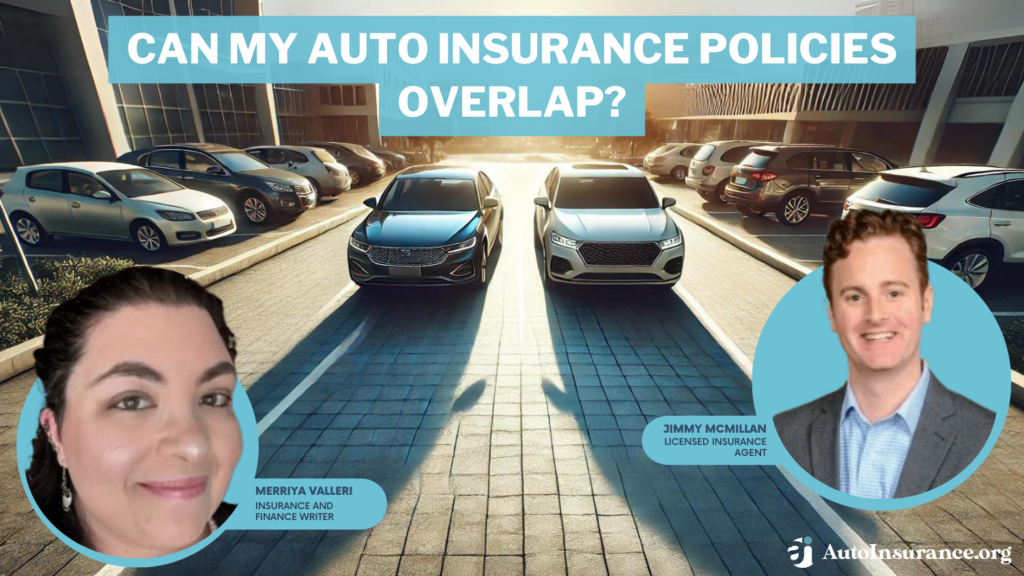
Can you have your auto insurance overlap? Although it may be legal in some states, it’s never wise to have your car covered by two policies at the same time. You may think that with double insurance you get twice the protection, but the opposite is true. An insurance overlap can be as bad as having no insurance at all at the time of an auto accident.
- An insurance overlap is never a good idea even if it’s legal in your state
- Both insurance companies may find out and then refuse to pay, leaving you without coverage even though you paid double premiums
- Making claims to two different insurance companies on one accident is unjust enrichment and is illegal
Can auto insurance policies overlap?
People occasionally take out two insurance policies for their car simultaneously, but overlaps can also happen due to various other factors, such as having two car insurance policies for one person or managing coverage overlap between two insurance plans.
Buying a New Car
Some auto dealerships offer automatic insurance coverage as an incentive to buy a car. When that policy is about to lapse, the renewal rates might be too high, so you look for coverage elsewhere. When you find cheaper auto insurance, you apply and get temporary coverage while the underwriter reviews your application. This is known as binding a policy. As a result, you wind up having coverage on your car with two different insurance companies.
Once your bound insurance is activated upon payment of the premium, it’s crucial to notify your previous insurance provider that you’ve switched to a new company. Inform them of the start date of your new insurance to prevent inadvertently having two insurance policies covering the same risk and to avoid being accidentally insured twice during a move.
Getting Married
It’s common for two people getting married to have their cars covered by two different companies. If you go with one company, you’ll get a family discount and better rates. You may choose to do this before the policy lapses on one of the cars, causing an insurance overlap.
Contact your old insurance company and let them know you’re going with another company. See if you can get a prorated refund on the old policy if you cancel the auto insurance early.
Wanting Extended Coverage
You may find it tempting to overlap policies to make sure your car is well-insured. Not only is doing so illegal in some states, it never works and could lead to both companies refusing to pay if you’re involved in an accident. Instead, sit down with your insurance agent and talk about the types of coverage you need.
Most insurance companies can add more coverage to your policy at a minimal cost. That way you get extended coverage without having to pay two different premiums.
Free Insurance Comparison
Compare Quotes From Top Companies and Save
Consequences of Having Double Coverage
Whether it’s deliberate or by oversight, having an insurance overlap can be a disaster if you’re in an accident and file a claim:
- Insurance companies will find out. The insurance company you file a claim with will find out you have another policy on the same car. The company you file with may insist you file with the other company. The other company may do the same thing.
- Insurance companies may argue. The two insurance companies may get into a legal battle over which company has to pay. You’ll be the one who loses.
- Insurance companies may accuse you. Both companies may accuse you of unjust enrichment, meaning you hope to profit by filing two claims. The purpose of insurance is to make you whole, not make you richer. You may face criminal charges as a result.
- Insurance companies may be slow to compensate. Even if it’s legal to have two insurance policies in your state, expect a long wait for compensation while the two companies argue over who pays what.
How To Avoid an Overlap
To prevent having overlapping coverage with your car insurance, it’s essential to monitor when your current policy ends. Take proactive steps to cancel it on the day your new policy starts. This approach also applies to managing health insurance overlap during job changes or having two health insurance policies. Additionally, ensure clarity when adding a restricted driver to your insurance policy.
Talk to Both Insurance Companies
If you’re unhappy with your current policy, shop online until you find an insurance company with better rates. Then talk to an agent at the new insurance company. Be honest about your driving history along with any at-risk drivers in your family. That way there won’t be any delays in activating your new policy.
Also, talk to your agent who is with your old insurance company. Let the agent know the activation date of your new policy and say you want your old policy canceled on that date.
Draft a Cancellation Request
Once you get your new policy, write a cancelation request asking that your policy be canceled on that same day that your new policy was activated. Submit your request to your old insurance company.
Deal With a Lapse In Coverage by Backdating
Sometimes a delay on the part of your new insurance company may cause you to be without coverage for a few days. This can be a problem in a state where it’s against the law to be without insurance coverage. In that case, ask your new insurance company to backdate your policy. Depending on the state in which you live, you can have a policy backdated for up to 60 days. You’ll need to provide a letter stating you had no known loss during that time.
Don’t Allow Double Coverage To Happen
Having two active insurance policies on your car simultaneously, whether due to seeking additional coverage or an oversight, is strongly discouraged. This practice, often referred to as overlapping insurance policies, can lead to complications. Insurance providers may view it as double-dipping, potentially resulting in them denying your claim in the event of an accident. It’s crucial to take proactive steps to cancel any redundant policies promptly. This applies particularly when considering the differences between one-way vs. two-way insurance or when insuring a car with two policies.
Frequently Asked Questions
Can my auto insurance policies overlap?
Auto insurance policies can overlap in specific situations, such as having multiple policies covering the same vehicle or type of coverage. While overlapping can enhance protection, it’s crucial to grasp the implications and potential outcomes, particularly concerning double auto insurance coverage and overlaps during vehicle changes.
Why would I have overlapping auto insurance policies?
There are a few reasons why you might have overlapping auto insurance policies:
- Multiple vehicles: If you own multiple vehicles, you may have separate insurance policies for each vehicle, resulting in overlapping coverage.
- Multiple drivers: If you have multiple drivers in your household, each with their own insurance policy, there may be overlap in coverage for the same vehicle.
- Additional coverage: You may choose to purchase additional coverage, such as rental car insurance or roadside assistance, which can overlap with the coverage provided by your primary auto insurance policy.
What are the potential benefits of overlapping auto insurance policies?
Overlapping auto insurance policies can offer certain benefits, such as:
- Increased coverage limits: Having multiple policies can provide higher coverage limits than a single policy alone, offering greater protection in case of a major accident or loss.
- Additional benefits: Each policy may come with its own set of benefits or features that can complement the coverage provided by the other policy.
- Redundancy and backup: If one insurance policy has limitations or exclusions, having overlapping coverage can act as a backup to ensure you have adequate protection.
What are the potential drawbacks of overlapping auto insurance policies?
While overlapping auto insurance policies can offer advantages, there are potential drawbacks to consider:
- Increased costs: Having multiple policies means paying premiums for each policy, which can increase your overall insurance costs.
- Policy limitations: Each policy may have its own terms, conditions, and limitations. Understanding these details and potential conflicts between policies can be complex.
- Claim coordination: In the event of a claim, coordinating between multiple insurance providers may lead to delays or complications.
- Unnecessary coverage duplication: Overlapping coverage can result in paying for coverage you don’t actually need, which can be financially burdensome.
What should I consider when deciding whether to have overlapping auto insurance policies?
When considering overlapping auto insurance policies, it’s important to:
- Review policy terms: Understand the terms, conditions, and coverage provided by each policy to identify potential overlaps and conflicts.
- Evaluate costs: Assess the premiums associated with each policy and determine if the added coverage justifies the additional expense.
- Assess coverage adequacy: Consider if the coverage limits and benefits provided by your primary policy are sufficient for your needs. If not, overlapping coverage may be beneficial.
- Coordinate with insurance providers: Communicate with your insurance providers to understand how the policies will interact in case of a claim and any potential coordination issues.
Will having overlapping auto insurance policies increase my claim payout?
Having overlapping auto insurance policies does not guarantee an increased claim payout. The total claim payout will depend on the terms and conditions of each policy and the specific circumstances of the claim.
Can I file a claim with multiple insurance companies for the same incident?
In most cases, you cannot file a claim with multiple insurance companies for the same incident to receive duplicate compensation. Insurance policies typically contain coordination of benefits provisions that prevent double recovery.
Are there any legal issues with having overlapping auto insurance policies?
Generally, there are no legal issues with having overlapping auto insurance policies as long as you disclose the existence of multiple policies to the insurance companies. However, it’s crucial to comply with the insurance regulations in your jurisdiction and follow the terms and conditions of each policy.
Can car insurance overlap?
Yes, car insurance can overlap under certain circumstances where multiple policies cover the same vehicle or risks.
Can you have two insurance policies on one car?
Yes, it’s possible to have two insurance policies on one car, but you should coordinate with both insurers to avoid coverage issues.
What happens if you have overlapping car insurance policies?
Can a person have two medical insurance policies?
Can a person have two car insurance policies?
Can a vehicle be insured by two different companies?
Can I be covered under two health insurance plans?
Can I have car insurance from two different companies?
Can I have car insurance in two different states?
Can I have more than one insurance policy?
Can I have two auto insurance policies?
Can you have two different car insurance companies?
Can you have two different car insurance policies?
Can you have overlapping health insurance?
Can you have two car insurance policies on two different cars?
Can you have two Gap insurance policies?
Can you have two health insurance policies with the same company?
Can you have two insurance policies on the same car?
How does secondary insurance work?
How many car insurance policies can I have?
How to report an illegal car?
Is it illegal to have two car insurance policies?
Is it illegal to have two car insurance policies on one car?
Is it illegal to have two health insurance policies?
What happens if you have two car insurance policies at the same time?
Is it okay to have two medical insurance policies?
What happens if car insurance overlaps?
Related Articles
-
Apr 2025

Do all vehicles have set auto insurance requirements? (2026 Coverage Facts)
-
Sep 2026
What is an auto insurance score? (2026)
-
Dec 2024
Replacement Cost vs. Actual Cash Value in 2026 (Differences Explained)
-
Dec 2024
Can you change the date that your auto insurance payment is due? (2026)
-
Dec 2024
What You Should Do If Your Auto Insurance Expired Yesterday
-
Dec 2024
Who is covered on my auto insurance?
Get a FREE Quote in Minutes
Insurance rates change constantly — we help you stay ahead by making it easy to compare top options and save.