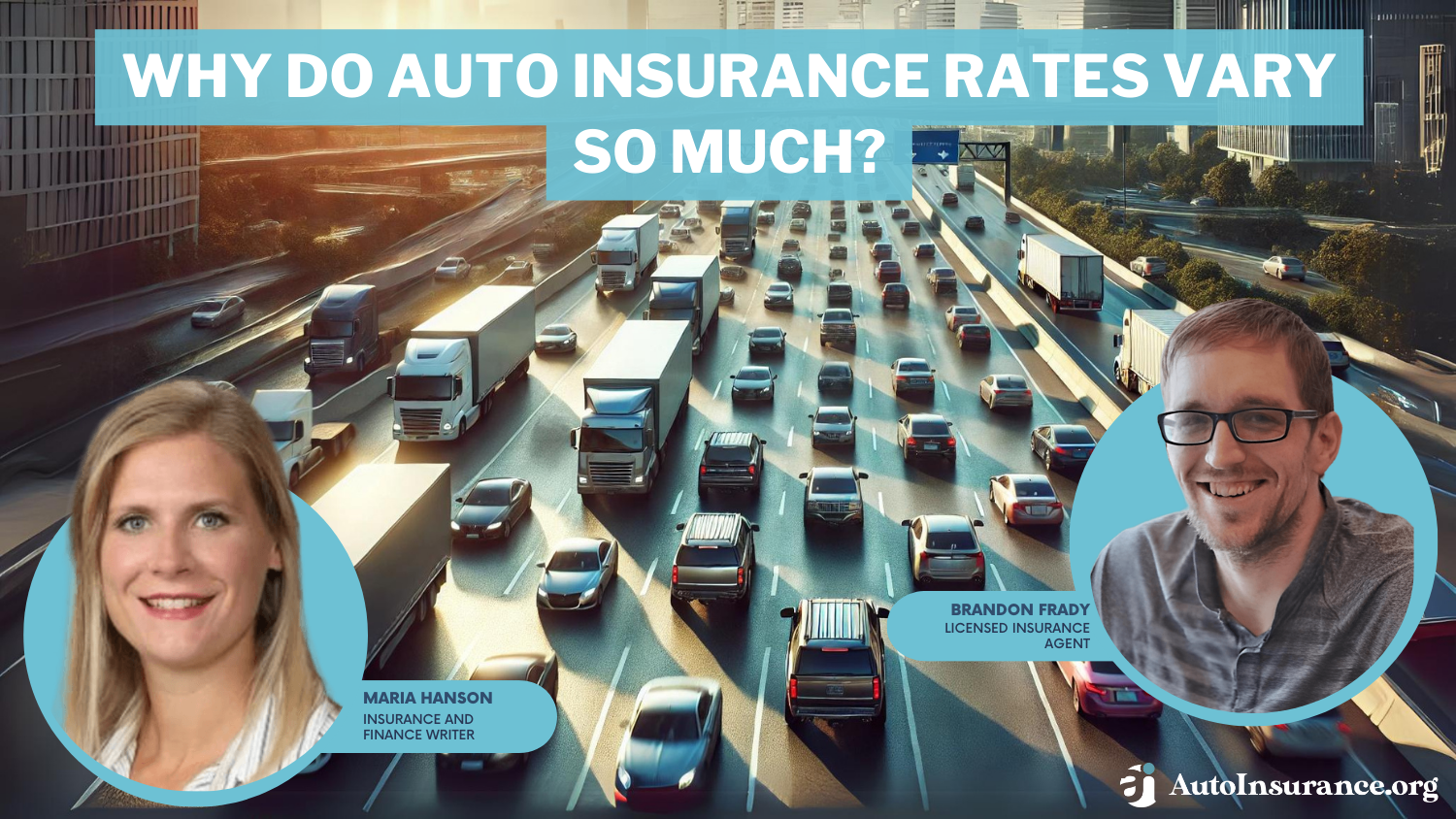
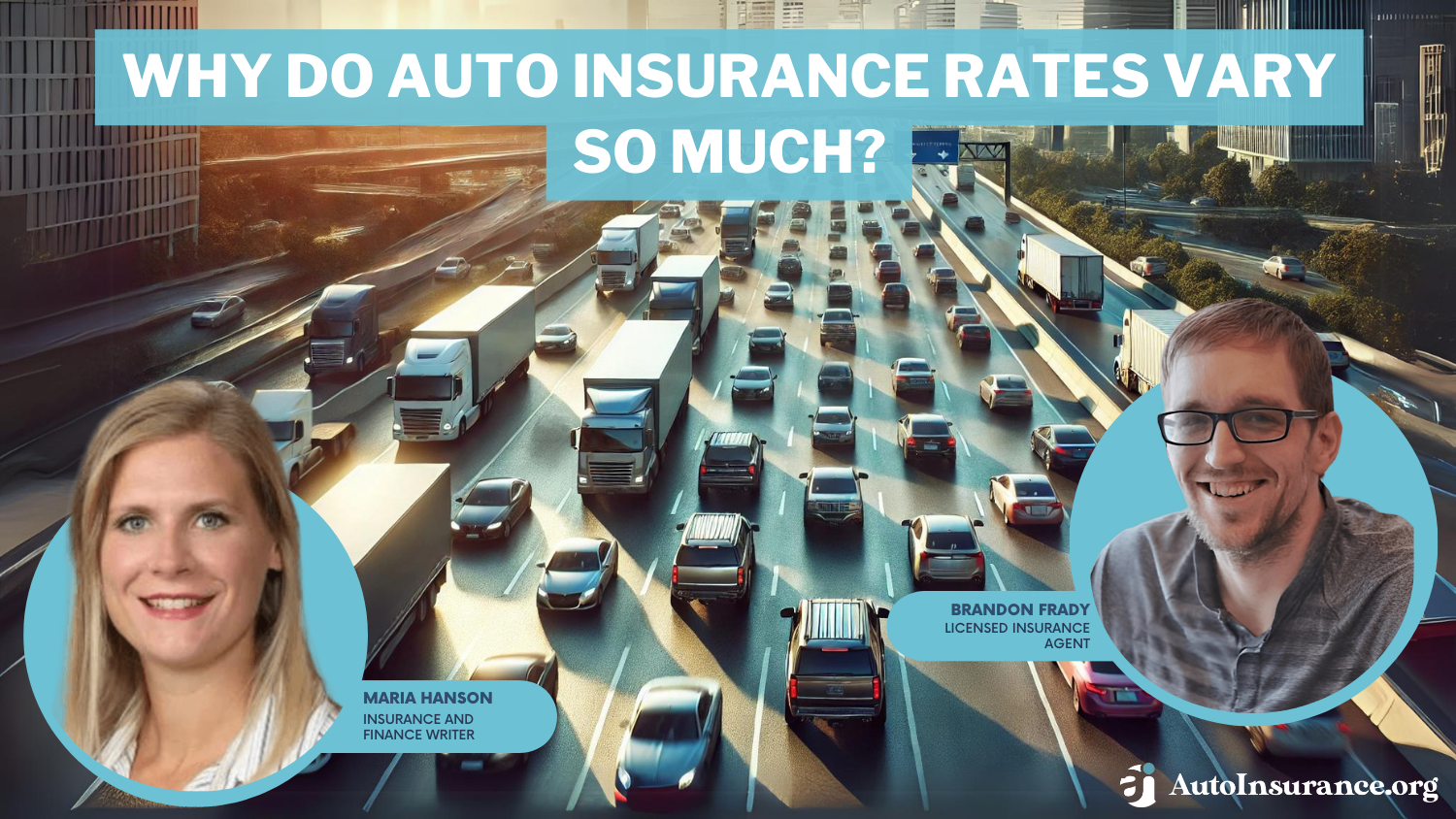
Why do auto insurance rates vary so much? (2026)
To stay profitable, insurance companies will target a specific market by setting low rates for certain risk classes. The average liability rate in the U.S. is $538.73.






Table of Contents
Table of Contents

Insurance and Finance Writer
Maria Hanson grew up with a unique passion and understanding of both the automotive and insurance industries. With one grandfather in auto mechanics and another working in insurance, you could say automotive insurance is in her blood. Her love of research and finance serves her well in studying insurance trends and liability. Maria has expanded her scope of expertise to home, health, and life...
Maria Hanson

Licensed Insurance Agent
Brandon Frady has been a licensed insurance agent and insurance office manager since 2018. He has experience in ventures from retail to finance, working positions from cashier to management, but it wasn’t until Brandon started working in the insurance industry that he truly felt at home in his career. In his day-to-day interactions, he aims to live out his business philosophy in how he treats hi...
Brandon Frady
Updated December 2024
Most people don’t walk around in public asking perfect strangers how much they pay for auto insurance. It is common, however, for friends and family members to discuss their rates and whether or not they’re satisfied with their insurance carriers.
As you share your frustrations, it can be even more frustrating to learn that your best friend or your brother pay less for coverage than you do. After all, they’ve gotten all of those violations over the years, right?
What you might not know is that comparing rates from household to household can be difficult and ineffective due to how personalized they are.
If you’d like to learn why rates vary and what goes into calculating car insurance premiums, read this guide to find out.
Start comparing car insurance rates now by using our FREE tool above!
Auto Insurance Companies Set Their Own Unique Rating Systems
Before a company can even begin accepting applications, they must have a thorough and well-designed rating system. While some believe that insurance is a highly regulated marketplace where all insurers charge the same base rates, that’s not the case.
While there is regulation, the regulation through the state department of insurance doesn’t get in the way of marketplace competition.
Insurance companies are free to set their own base rates and develop their own algorithms that represent risk classes and then represent how much the carrier needs to collect to stay profitable even when a lot of claims are filed.
This is why shopping the market is so important when you want to find the best rate.
Free Insurance Comparison
Compare Quotes From Top Companies and Save
How are rates actually set by insurance companies?
A rate is technically a price per unit of insurance. Since insurers are public businesses that need to stay profitable, they’ll focus on determining how much needs to be collected to cover both the losses and the expenses of the company while also allowing for profit.
Here’s a breakdown of how rates are made internally by actuaries:
- Pure Premium – Actuaries use studies to calculate the pure premium to determine what needs to be collected to pay for losses
- Loading Calculations – Added to the pure premium is the loading, which will address the additional premium need to cover overhead and operational costs. This portion is what allows for a profit
- Gross Rate – The Gross Rate is the Pure Premium and Loading Calculations added together. This is the base number used when an application is being evaluated
- Gross Premium – The Gross Premium is what’s charged to the insurance applicant based on the number of units of insurance that the insured is applying for
Are the rates set by insurers regulated?
It might sound as if an insurer is free to charge whatever rates they want no matter how exorbitant they might be. While the state doesn’t set the rates so that the marketplace can stay competitive, they do regulate them very closely.
In fact, all licensed insurers doing business in the state must file their rates for approval before they are charged to applicants. Some of the reasons why insurance rates are regulated include:
- To protect consumers from predatory rates
- To protect consumers from discrimination
- To maintain insurer solvency and to prevent bankruptcy and bailouts
- To ensure that risky drivers and other poor risks have access to insurance
Why is it important to shop for affordable auto insurance?
In the world of marketing, it’s important for a company to select a target market when they are setting product pricing. You might think it’s possible for a company to offer competitive pricing across the board if they lower their loading, but that’s not the case.
Almost all companies in the industry will create a plan that’s tailored to set rates that’ll target drivers in a specific demographic.
This is why one company might offer excellent pricing to one household in comparison to expensive rates for another.
By shopping around for coverage, you’ll be able to see firsthand how much one company will charge you based on your personal information.
Auto insurance is a risk pool and the companies must assign each household to a different class within this pool. Here are the different classes you can be assigned to in order from cheapest to most expensive:
- Preferred risk
- Standard risk
- High risk
Free Insurance Comparison
Compare Quotes From Top Companies and Save
What is used to assign an auto insurance applicant to a risk class?
There are several different price determinants that’ll be used to assign a household to a risk class above. Here’s a breakdown of some of the different factors that can change your class assignment for the better or the worse:
- Driving record and accident history
- Age, gender, marital status, and driving experience
- Vehicle type or safety record
- Features vehicle is equipped with
- How much the car is used and where it’s parked
- The applicant’s credit
- The type of coverage and amount
Now that you can see how rates are unique from carrier to carrier, you can see why you might pay more or less for coverage than a friend. If you’d like to find the right company where you can get competitive rates, it’s time to start shopping.
Use an online brokerage-style quoting tool, and you can find the company priced right in your market. Start comparing insurance rates now by entering your zip code in our FREE tool below!
Frequently Asked Questions
Why do auto insurance rates vary so much?
Auto insurance rates can vary due to several factors, including the individual’s driving record, age, gender, location, type of vehicle, coverage options, and even the insurance company’s underwriting guidelines. Each insurance company assesses risk differently, which leads to variations in rates. Additionally, external factors such as local traffic patterns, crime rates, and accident statistics can also influence rates.
How can I find the best auto insurance rate?
To find the best auto insurance rate, it’s recommended to shop around and obtain quotes from multiple insurance providers. Each company uses its own formula to calculate premiums, so comparing rates allows you to identify the most competitive option. Consider factors such as coverage limits, deductibles, discounts, and customer service reputation alongside the premium to make an informed decision.
Can I lower my auto insurance rates?
Yes, there are ways to potentially lower your auto insurance rates. Some strategies include maintaining a good driving record, taking defensive driving courses, installing safety features in your vehicle, bundling multiple insurance policies with the same provider, opting for a higher deductible, and asking about available discounts such as safe driver discounts, multi-policy discounts, or discounts for low mileage.
Why do younger drivers usually have higher insurance rates?
Younger drivers typically have higher insurance rates due to a higher perceived risk. Statistically, inexperienced drivers have a higher likelihood of being involved in accidents compared to more seasoned drivers. Insurance companies factor in this increased risk when determining rates for younger drivers. As drivers gain experience and demonstrate safe driving habits, their rates generally decrease.
Can my credit score affect my auto insurance rates?
Yes, in many cases, your credit score can influence your auto insurance rates. Insurance companies use credit-based insurance scores to assess risk. Studies have shown a correlation between credit history and the likelihood of filing insurance claims. Individuals with lower credit scores may be considered higher risk and may be offered higher insurance rates as a result.
Get a FREE Quote in Minutes
Insurance rates change constantly — we help you stay ahead by making it easy to compare top options and save.